
Rental Property Management Software: An Honest Owner Guide

Editorial Staff
Content published by Hemlane is created and reviewed by members of our editorial team, including experienced technical writers and real estate professionals.
A spreadsheet for rent. A payment app for the deposit. A text thread for repairs. A folder with the lease, somewhere. Most owners start this way. It works until a payment goes missing or a tenant texts at 2 AM about a leak.
This guide follows one rental from listing to deposit refund. At each step you'll see what the software runs. You'll see what still needs your decision. And you'll see where a local person has to show up. You call the shots the whole way. We handle the rest.
How does rental property management software work?
It puts the whole tenancy in one place. You add the property, list it, screen applicants, sign the lease and invite the tenant to a portal. Then rent comes in on schedule. Every payment lands in a ledger. The ledger builds your reports. Each step feeds the next, so you enter things once.
Here's the flow on Hemlane, step by step.
- Add the property. You enter the address, the rent, the deposit and the bank account rent should land in. The tenant sees nothing yet.
- List it. Your listing goes out to Apartments.com, Zillow and 7 more top websites. Inquiries come back to one inbox. Don't want to spend your weekends on showings? A local agent can run them. Tenant Placement covers basic listing and showings. A digital lockbox adds $100. Leasing Services goes further. It adds rent-ready coordination, premium advertising across 15+ sites, application processing and lease signing, with showings 7 days a week.
- Screen applicants. Applicants apply online. Screening covers national credit, criminal, eviction and income reporting. The report informs you. You make the call. If you deny someone because of something in a screening report, federal law requires you to notify them, as the Consumer Financial Protection Bureau explains. That duty stays with you. This is general information, not legal advice.
- Sign the lease. Hemlane creates a state-specific lease and collects e-signatures. The tenant signs on screen. The signed copy sits with the rest of the tenant's records. See how leases are created and signed.
- Invite the tenant. The tenant gets a portal. They see their lease, what's due, how to pay and where to send a repair request. You see the owner side: every unit, payment and request on one dashboard.
- Collect rent. Tenants pay by ACH, card or Cash App. ACH costs you $0. Rent goes straight to your bank in 2 to 3 business days. Only business days count. The banking system doesn't settle payments on weekends or federal holidays. So rent paid over a long weekend reaches you later than rent paid on a Tuesday. Here are the details on online rent, payment methods and payout timing.
- Let the ledger fill itself. Each payment posts to the property ledger. Bank sync pulls in the rest. That matters at tax time. Good records let you track deductible expenses, prepare your return and back up what you report on it.
- Pull reports. Cash flow, income statements, rent rolls, tenant ledgers and Schedule E reports come straight from the ledger. No manual exports. See the reports the ledger produces.
Repairs run alongside all of this. Tenants submit requests online. You assign the work order to a vendor and track it in one place. On the Essential and Complete plans, our repair coordination team can take the call for you. For in-person work, we pair the platform with local leasing agents across all 50 states.
What does rental property management software automate between a tenant's move-in and move-out?
Most of the routine. Autopay, rent reminders, late fees, the ledger, renewal reminders and year-end tax reports run on their own. Repairs are assisted: the request flows in and you approve the work. Inspections, rent changes, deductions and the deposit refund stay manual. Those need your judgment, and often a person on site.
The Basic plan covers the core of a tenancy: lease tracking, document storage, rent collection and tenant messaging. Here's how a tenancy breaks down.
Stage | What the software does | What you still decide | Type |
|---|---|---|---|
Move-in documents | Stores the signed lease and tenant records in one place | What your state requires you to hand over at move-in | Assisted |
Move-in inspection | Stores the report with the tenant's documents. Inspections are available as a service add-on. | Whether to book one and what gets noted | Manual |
Recurring rent | Runs autopay and payment reminders. $0 ACH fees. Deposits to your bank in 2 to 3 business days. | The rent and due date in the lease | Automated |
Late fees | Charges late fees automatically. 100% go to you. | The fee and grace period, within your lease and state law | Automated |
Repairs | Takes requests through an online portal with real-time status. 24/7 coordination on Essential and Complete. | Which repairs to approve and who does them | Assisted |
Renewal | Sends reminders up to 90 days before the lease ends | Whether to renew | Assisted |
Rent changes | Sends the new lease for e-signature | Whether to raise the rent and by how much, within your state's rules | Manual |
Move-out notice | Keeps tenant messages in one place | Move-out dates and the walk-through | Assisted |
Move-out inspection | Inspections are available as a service add-on | What counts as damage | Manual |
Deposit return | Shows the deposit on the tenant ledger | Deductions, the statement and the refund deadline | Manual |
Year-end taxes | Builds a tax-ready Schedule E report from the ledger | Review with your tax preparer | Automated |
Some duties come back every year. In Massachusetts, for example, deposit interest is payable to the tenant each year on the anniversary of the tenancy. That's one state's rule, not a national one. But it's the kind of date that belongs on a reminder, not in your memory.
The year-end row is the payoff. Your tax records must support the income and expenses you report. Generally, they're the same records you use to run the property. Log the year as it happens, and your tax file is mostly built.
Leaks don't wait for Monday. On Essential and Complete, our 24/7 Repair Coordination team handles tenant requests after hours and on weekends. You still approve the work. See how repair requests and after-hours coordination work, or get the full picture of how Hemlane supports owners.
How does rental property management software handle security deposits?
Software can record the deposit, keep it off your income and store the proof you'll need at move-out. It can't set your deadline, decide a deduction or make you compliant. State law controls most of a deposit's life, and the rules vary a lot by state. Use the software as your record keeper. Check your state's rules yourself.
Deposits are where owners lose money and end up in disputes. A missed deadline. A deduction with no receipt. A deposit booked as rent. Here's one deposit, start to finish.
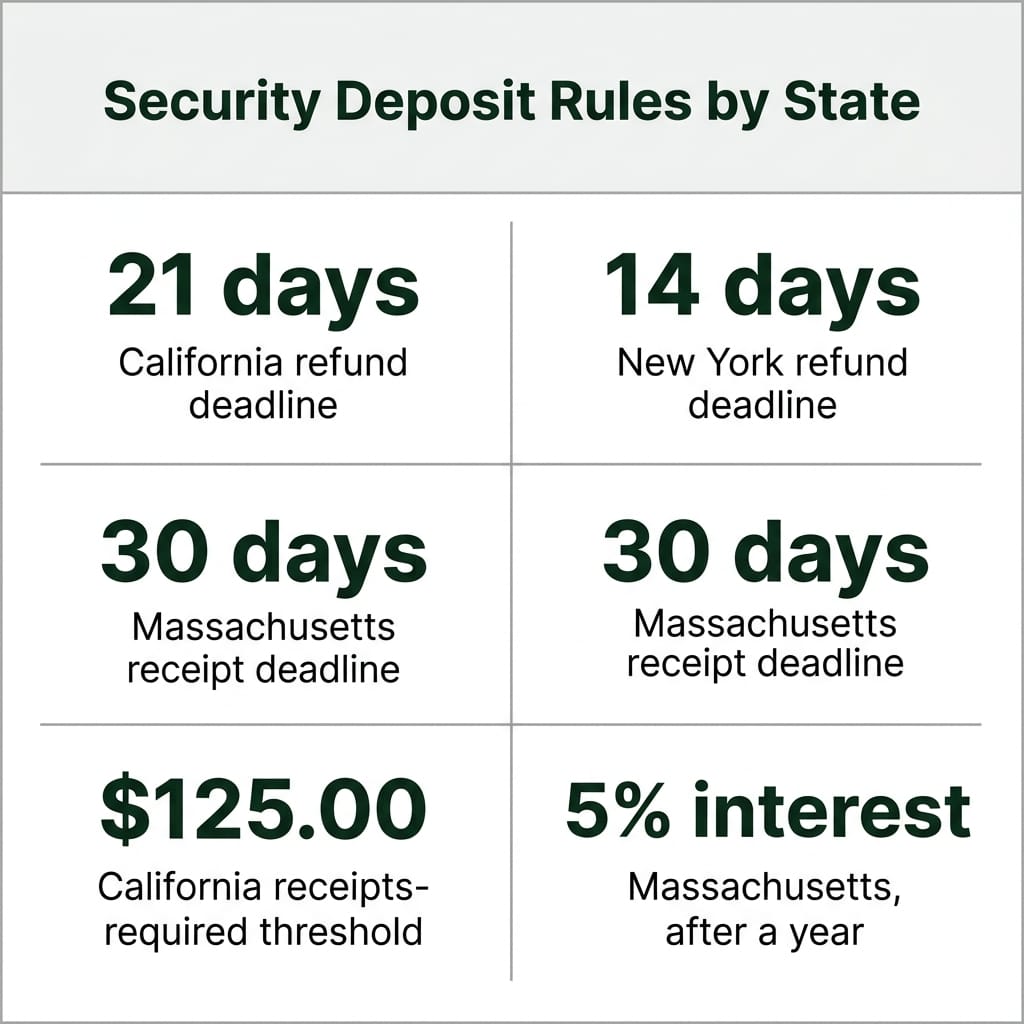
- Collect it. Record the amount and the date the day it arrives. Some states add a step here. In Massachusetts, the tenant must get a receipt within 30 days of the deposit being received, according to Mass.gov.
- Record it as a liability. A deposit you plan to return is the tenant's money, not yours. Don't include it in your income when you receive it if you plan to return it at the end of the lease. With full rental accounting and bank sync, the deposit shows on the tenant ledger apart from rent.
- Hold it where your state allows. Some states control where the money sits. Massachusetts requires a separate, interest-bearing account in a Massachusetts bank. Once a tenant has lived there at least a year, they're entitled to 5% interest or the lesser amount the bank pays. Where your deposit sits is your decision, within your state's rules.
- Document the move-in condition. Dated photos and a written report, stored with the tenant's records. Inspections are available as a service add-on if you can't be there.
- Document the move-out condition. Same rooms. Same angles. Same detail. The gap between the two reports is your evidence.
- Deduct with proof. Every deduction needs a reason and a record. In California, if deductions total more than $125.00, copies of invoices or receipts must go with the itemized statement, per the Judicial Branch of California. Repairs on Hemlane are invoiced with no markups, so the invoice shows what the work cost.
- Send the itemized statement. List each deduction and the amount being returned. Your state decides what the statement must include.
- Refund by the deadline. Deadlines differ a lot. California gives 21 days after move-out to return the deposit, or return it minus deductions with an itemized statement. In New York, for units that aren't rent stabilized or rent controlled, the deposit is due back within 14 days of move-out, says the New York State Attorney General. Any part you keep because the tenant broke the lease terms counts as income in the year you keep it.
Before move-in, check these for your state:
- The return deadline after move-out
- What the itemized statement must include, and whether receipts must be attached
- Whether the deposit must sit in a separate or interest-bearing account
- Whether interest is owed, how much and when
- Whether the tenant must get a receipt, and by when
The Essential plan includes state-specific lease documents, which helps set clear terms from day one. But software tracks. It doesn't give legal advice, and it won't settle a deposit dispute on its own. Compliance stays your responsibility.
What type of landlords benefit most from rental property management software?


Owners who run their own rentals get the most from it, and that's most small rentals. It fits remote owners, first-time owners, owners with full-time jobs, investors growing across states and property managers serving owners. It fits less for large multifamily communities that need self-touring and high-volume leasing tools.
The numbers back this up. Federal survey data from a few years back found only about 22 percent of small rental properties (1 to 4 units) are professionally managed. For properties with 150 or more units, it's 84 percent. The same older data found individual investors own about 70 percent of rental properties, holding 38 percent of all rental units. Newer federal data shows the same split. Individual investors owned 58.8% of rental homes in 2 to 4 unit properties, but just 4.6% in properties with 50 or more units.
Small owners mostly do the work themselves. They deserve the same tools a large operator has. Here's who gets what.
Your situation | Main pain | What matters most |
|---|---|---|
Remote or out-of-state owner | You can't be there for showings, inspections or key handoffs | Local support while you monitor from anywhere, with licensed local agents in all 50 states |
First-time or accidental owner | You don't know the steps or the paperwork | A guided flow, screening reports and state-specific leases |
Owner with a full-time job | Repair calls and rent chasing land during work | Autopay, reminders and 24/7 repair coordination on Essential and Complete |
Investor growing across states | Different rules and too many logins | One login, state-specific leases and reports by property or entity |
Property manager serving owners | Owners want to see everything | Owner statements formatted for sharing, by property, owner, entity or portfolio |
Large multifamily community | High-volume leasing, self-touring and smart access | A specialized multifamily leasing tool may suit you better |
We support over 20,000 rental properties in 4,418 cities across the United States. Our partner agents are local. One in Richmond, Virginia, points to deep roots in the area and close knowledge of its market, neighborhoods and regulations. See how local agents pair with the platform nationwide.
Manage your rentals on Hemlane
Is property management software worth it for landlords with only one rental?
Often, but not always. With one door, our free Starter plan already covers screening, rental accounting and listing. Paying makes sense when you want rent collected online, a state-specific lease or someone else on the after-hours repair call. If your tenant is long-term, you live close by and your records are tidy, a spreadsheet may be enough.
You're in good company either way. Older federal survey data found individual investors own 70 percent (15.9 million) of small rental properties. Only about 22 percent of small rentals are professionally managed. Most one-door owners do the work themselves.
One door still carries real paperwork. The IRS says you must be able to document your rental income and expenses if your return is selected for audit. That generally means receipts, canceled checks or bills for your expenses. A careful folder can do that. So can a ledger that records every payment for you.
Worth it if | Probably not if |
|---|---|
You live far from the rental | You live next door and handle repairs yourself |
Rent arrives late or through scattered apps | A long-term tenant pays on time, the same way, every month |
You're between tenants and need to screen | Your lease is set and no turnover is coming |
Your receipts are spread across email, apps and paper | You already keep clean books with every receipt filed |
You don't want the 2 AM call | You're handy and fine being on call |
You're unsure of your state's lease and deposit rules | You know them and have a current state lease |
Which plan fits one rental? Paid plans are priced per unit monthly after a 14-day trial, with annual billing discounts available.
- Starter, free: tenant screening, rental accounting and listing to major websites. Fits an owner who mainly needs to fill the unit and keep books.
- Basic, $30/mo (incl. $28 platform fee): adds lease tracking, document storage, rent collection and tenant messaging. Fits an owner who wants rent and records in one place.
- Essential, $48/mo (incl. $28 platform fee): adds a dedicated repair coordinator, 24/7 emergency support and state-specific lease documents. Fits a remote or busy owner.
- Complete, $86/mo (incl. $28 platform fee): adds a property management assistant, vetted repair network access and VIP support. Fits an owner who wants most of the admin off their plate.
Owners rate Hemlane 4.8 stars on Capterra, GetApp and Software Advice. Compare tiers on our pricing page, or read our owner's guide to software costs for a deeper breakdown before you choose.
Get started with Hemlane
Frequently Asked Questions
Does QuickBooks integrate with property management software?
Some does, and Hemlane is one. Our lease management tools list integrations with QuickBooks. Hemlane also has full rental accounting built in, with bank sync, cash flow reports and income statements. Some owners keep their books inside the platform. Others keep QuickBooks. If QuickBooks is staying, confirm how the connection fits your setup before you switch.
Does rental property management software work on a phone?
It should, for you and your tenant. Nearly everyone carries one. 97% of adults under 50 and 90% of those 50 to 64 have a smartphone. About 16% of Americans are smartphone dependent, double the share of a decade ago. For them, the phone is the only way online. Renters want this too: in one large renter survey from some years back, 78 percent said they prefer paying rent online. With Hemlane, you monitor your rentals from anywhere. Tenants submit repair requests through an online portal and track the status in real time.
What customer support should rental property management software include?
Two kinds. Help when you're stuck in the software, and help when a tenant calls at 2 AM. The second is where most tools stop. On our Essential and Complete plans, a 24/7 Repair Coordination team handles tenant requests after hours and on weekends. Essential includes a dedicated repair coordinator and 24/7 emergency support. Complete adds VIP support and a property management assistant. We've completed 61,218 service requests, and users rate us 5 stars. If after-hours coverage matters to you, look at Essential or above.
One rental or many, the job is the same. List, screen, sign, collect, repair, renew, refund. Software runs the routine. Local people cover what software can't. You keep every decision, $0 ACH fees and 100% of late fees.
Manage your rentals on Hemlane
Hemlane, Inc. is a technology company that helps you manage your long-term rental properties. Communications between you and Hemlane are protected by our Privacy Policy. Hemlane also provides access to independent licensed professionals and self-help services at your specific direction. We are not a property management firm. We cannot make any decisions on behalf of any property owners. Any content found in the Hemlane Academy is not a substitute for advice and ideas from a qualified legal source or expert. You are responsible for performing additional research to confirm you are complying with all laws applicable to your rental situation.
Sources


- Consumer Financial Protection Bureau — What should I do if my rental application is denied because of a tenant screening report? | Consumer Financial Protection Bureau · retrieved November 3, 2026
- Commonwealth of Massachusetts (Mass.gov) — Security deposits and last month's rent | Mass.gov · retrieved November 3, 2026
- Judicial Branch of California (Self-Help Guide) — Guide to security deposits in California | California Courts | Self Help Guide · retrieved November 3, 2026
- New York State Attorney General — Residential Tenants’ Rights Guide | New York Attorney General · retrieved November 3, 2026
- Internal Revenue Service — Tips on rental real estate income, deductions and recordkeeping | Internal Revenue Service · retrieved November 3, 2026
- Internal Revenue Service — Publication 527 (2025), Residential Rental Property | Internal Revenue Service · retrieved November 3, 2026
- Nacha — ACH Payments Fact Sheet | Nacha · retrieved November 3, 2026
- U.S. Department of Housing and Urban Development — HUD Archives: HUD and Census Bureau Release Findings of 2021 Rental Housing Finance Survey · retrieved October 26, 2026
- National Multifamily Housing Council — NMHC | Who Owns America's Apartments? Ownership Patterns Across Property Sizes and Markets · retrieved November 3, 2026
- Pew Research Center — Internet use, smartphone ownership, digital divides in the US: What we know | Pew Research Center · retrieved November 3, 2026
- National Multifamily Housing Council — NMHC | New Largest-Ever Apartment Rental Survey Highlights Amenities Consumers Want · retrieved November 3, 2026
Get the Latest in Real Estate & Property Management!
I consent to receiving news, emails, and related marketing communications. I have read and agree with the privacy policy.


