
Rental Property Services: Owner's Guide From Prep to Lease

Editorial Staff
Content published by Hemlane is created and reviewed by members of our editorial team, including experienced technical writers and real estate professionals.
Your tenant gave notice. Or the house already sits empty. Every empty week is rent you don't get back.
Most pages about rental property services list what a company does. Few show how the work gets done. This guide follows the real path, from rent-ready to keys handed over. Each step comes with a checklist, a benchmark or a cost. You make the calls. We show where help fits, and where it doesn't.
How do you get a house ready to rent?
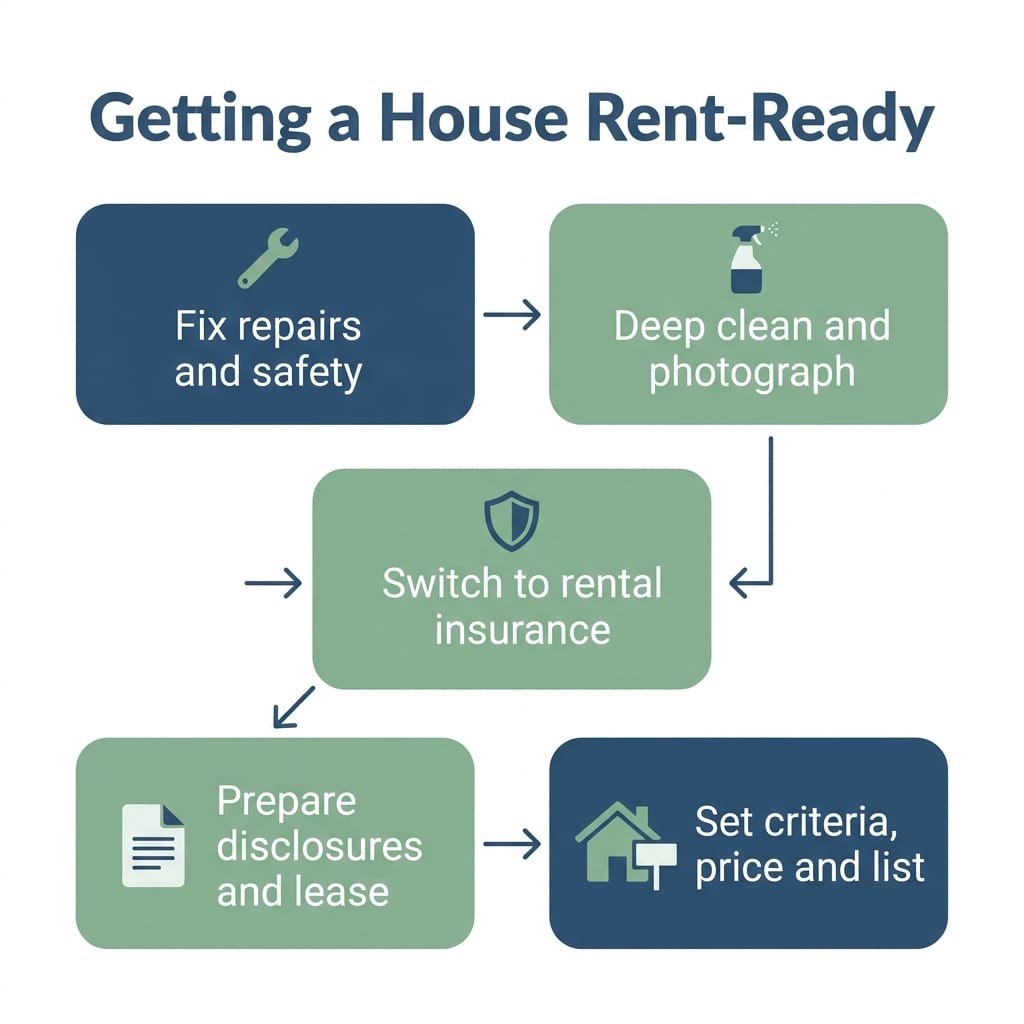
Work in order. Fix repairs and safety items first, then clean. Switch your insurance. Prepare the required disclosures and a lease written for your state. Set screening criteria before anyone applies. Then price it, photograph it and list it. Each step feeds the next. A skipped step costs you rent or adds risk.
This is a working list, not a full compliance list. State and local rules add their own items. Check yours as you go.
1. Repairs and safety
- Fix leaks, drips and running toilets.
- Check heat, hot water, locks and windows.
- Test every appliance that stays with the house.
- Put smoke alarms in every sleeping room, outside each sleeping area and on every level of the home. That is the standard fire safety experts recommend.
- Check your state's carbon monoxide detector rules. They vary from state to state.
2. Cleaning
- Deep clean the kitchen, baths and floors.
- Clean inside cabinets, the oven and the fridge.
- Replace burned-out bulbs and HVAC filters.
- Photograph every room once it's clean. A photo with a date beats a memory in a deposit dispute.
3. Insurance
- Call your insurer before the tenant moves in.
- A standard homeowner's policy usually isn't built for a rented house. In most cases, you'll need a policy built for rental owners instead.
- Ask what the new policy covers while renters live there.
4. Disclosures and lease
- Built before 1978? The U.S. Environmental Protection Agency's lead disclosure rule requires you to share what you know about lead-based paint and lead hazards before a renter signs. It covers most, though not all, pre-1978 housing.
- Check your state's own required disclosures. They differ.
- Use a lease written for your state. A generic form can miss what your state requires.
5. Screening criteria
- Write your standards before the first application lands. Cover income, credit, rental history and eviction history.
- Apply the same standards to every applicant, every time.
- Keep your criteria free of any preference tied to a protected class. More on that in the next section.
- Plan your denial notice now. The Federal Trade Commission's guidance on using consumer reports says this: if you reject someone, raise the rent or deposit, or require a co-signer based even partly on a report, you must tell the applicant. The notice can be written, electronic or spoken.
6. Pricing
- Compare similar rentals nearby on beds, baths, condition and move-in date.
- Price to the market, not to your mortgage. A wrong price at launch is the costliest mistake on this list. The timeline section shows why.
7. Photos
- Shoot in daylight, room by room.
- Include the outside, the yard and parking.
- Keep these apart from your dated condition photos.
Last step: listing
- Lead with rent, deposit, move-in date, beds and baths.
- Add pet policy, utilities and how to apply.
- Go live once, in the right places. The next section covers where.
Where we fit: our free Starter plan includes tenant screening with national credit, criminal, eviction and income reporting. It also covers rental accounting and listing to major websites. State-specific lease documents come with the Essential plan at $48/mo (incl. $28 platform fee) per unit. That plan adds a dedicated repair coordinator and 24/7 emergency support. Rather not run the make-ready yourself? Our Leasing Services include a rent-ready coordinator who gets the unit ready to show.
Where should owners advertise a rental listing?
Start with the major rental listing sites, ideally from one listing that goes out to many of them so you watch one inbox. Add a yard sign for local traffic, and the MLS if an agent works for you. Use social media and community boards with care. A large share of rental scams start there.
Five listing sites. Five logins. Five inboxes to watch. Post by hand and messages slip through. A missed message can be a lost renter.
Channel | Reach | Cost | Lead quality | Scam risk |
|---|---|---|---|---|
Major rental listing sites | Wide, where most renters search | Check each site's terms | Mixed; depends on how clear your listing is | Moderate; listings can be copied |
One listing sent out from a single platform | Wide, across many sites at once | Listing to major sites is on our free Starter plan | Better when applicants verify ID and apply in one place | Moderate; copies can still show up elsewhere |
MLS through an agent | Agents and their renter clients | Part of the agent's fee | Often strong; renters arrive with an agent | Lower |
Social media and community boards | Local and fast-moving | Mostly your time | Mixed to weak; many unscreened inquiries | High |
Yard sign | Neighbors and drive-by traffic | A sign and a stake | Good for local renters | Low |
Watch for scams that use your listing. The Federal Trade Commission's rental scam data shows nearly 65,000 rental scams reported since 2020, with about $65 million lost, as of December 2025. In the 12 months ending June 2025, about half of people who reported one said it started with a fake Facebook ad. The trick is simple. A scammer copies the photos and description from a real listing. They swap in their own contact details. Then they post it somewhere new.
That doesn't mean you stay offline. It means you check.
- Search your address a few days after you list.
- Find your photos with someone else's phone number? Report it to that site.
- Say in your listing how showings work and how to apply, so real renters can spot a fake.
Keep the ad fair-housing safe. The federal fair-housing advertising rule, published by the Legal Information Institute, makes it unlawful to publish any notice, statement or ad that shows a preference, limit or discrimination based on race, color, religion, sex, handicap, familial status or national origin. It covers anything you make, print or publish. A social post or a flyer counts the same as a listing site. State and local laws may protect more groups. Describe the home, not the ideal tenant. Skip phrases like perfect for a young couple or no kids.
A strong listing includes:
- Rent, deposit and move-in date
- Beds, baths and square footage
- Pet policy and which utilities are included
- Your screening criteria in plain words
- Clear photos of every room
- How showings work and how to apply
On Hemlane, one listing goes to Apartments.com, Zillow and 7 more top websites. Prospects are ID-verified and applications arrive complete. Want more reach? Our Leasing Services add premium advertising across 15+ sites, application processing and lease signing.
Get started with Hemlane.
How long does it take to find a tenant for a rental property?
Plan for about a month. National figures this year run from 17 days for single-family homes to about five weeks across rentals as a whole. Price, response speed and the season decide where your house lands. Price is the biggest lever, and you control it.
Here is how the current numbers compare:
- Apartment List: units leased in October had sat on the market an average of 36 days. That's up two days from the month before and a bit high for the season.
- ShowMojo, a showing-software company: homes leased in an average of 32.76 days in the spring quarter. That was its fastest spring pace since 2022.
- Rental Beast, a rental data company: single-family rentals leased in 17 days in the third quarter. Median days on market across rentals fell from 22 to 19.
Each source measures different homes. Treat the range as your planning window, not one number. The backdrop is crowded, too. National rental vacancy sat at 7.3 percent in the second quarter. Renters have choices.
Stage | What drives it | Who controls it |
|---|---|---|
Prep | Repair scope, contractor availability | You |
Listing | Price, photos, where it runs | You |
Showings | How fast you respond and how often you can show | You, or whoever shows for you |
Applications | Clear criteria and an easy way to apply | You |
Screening | Report turnaround, how fast applicants respond | Shared |
Lease signing | A ready lease and e-signing | You |
Move-in | Deposit, keys, move-in inspection | Shared with the tenant |
Price is the lever that matters most. Listings priced wrong at launch take about twice as long to lease: 51 to 58 days, against 24 to 29 for listings priced right. That gap is close to a month of rent. Fix the price before you fix the trim.
When a listing stalls, make one move. Two weeks in and behind on inquiries and showings? Cut the price once, and cut enough to matter. One clear cut beats three small ones.
Answer fast. Most renters lease with the first company that engages with them. A reply the next morning can lose a renter you'd have signed.


Know your season. Time on market swings with the calendar. Right now it is rising, as units sit empty longer in the slow season. A late-fall listing needs a sharper price than a spring one.
On Hemlane, tenants are placed faster than the market average: 25 vs. 33 days in California, 29 vs. 35 in Kansas and 26 vs. 47 in Texas. Our Leasing Services reduce days on market by 26% and run showings 7 days a week. Those are averages, not a promise for your house. Your price and your market still decide.
Is it worth using a real estate agent to find a tenant for a rental?
It depends on your time, your distance from the house and how many doors you own. An agent usually charges between one month's rent and a percentage of the year's lease value. Owners often pay the tenant's agent too. If you live close and can show the house, software may be enough.
Here are the four routes side by side.
What to compare | Self-leasing with software | Leasing-only service | Real estate agent | Full property manager |
|---|---|---|---|---|
How it charges | Free on our Starter plan; Basic is $30/mo (incl. $28 platform fee) per unit after a 14-day trial | Our Tenant Placement (plus $100 for a digital lockbox) or our Leasing Services. Standalone placement fees elsewhere average close to a full month's rent | Commission, typically one month's rent up to a percentage of annual lease value | A placement fee, often well over half a month's rent, plus a share of collected rent, on average a bit under a tenth |
Listing | Yes, to major sites | Yes | Yes, often through the MLS | Yes |
Showings | You | Yes | Yes | Yes |
Screening | Reports through the software; you decide | Our Leasing Services process applications; you choose | Varies by agent | Yes |
Lease | You; state-specific documents on our Essential plan | Lease signing in our Leasing Services | Varies by agent | Yes |
Ongoing management | You | You | Usually not | Yes |
What stays with you | Every task and every decision | Every decision, plus life after move-in | The decisions, plus life after move-in | Ownership; many day-to-day calls move to the manager |
Two things to know before you pick. First, the owner often pays the agent's commission, especially in competitive markets, and that can include the tenant's agent. Redfin, a real estate brokerage, describes this as the more common setup. Second, a full manager's fee runs every month the contract lasts. The true cost is the placement fee plus a slice of every rent check.
Who should pay for help, and who shouldn't:
- You live near the house, have free evenings and own one or two doors: self-lease with software.
- You live far away, or your weekends are already gone: pay for showings through a leasing-only service or a local agent.
- You need a renter fast in a tight market, and the agent works with renters: the commission can be worth it.
- You want out of day-to-day operations and accept handing over control: a full manager.
- You want to keep every decision but drop the legwork: software plus a licensed local agent.
That last route is how we built Hemlane. Licensed local agents handle what software can't: showings, inspections, key handoffs and local-court coordination. Local agents on Hemlane are priced at $60/month for the first rental and $30/month for each additional rental, billed annually. See how local agents and the platform work together nationwide. Or meet one, like leasing specialist Preda Mendez-Lopez, who brings 17 years of real estate and property management experience.
We are a technology company, not a property management firm. We make no decisions on your behalf. 100% of rent is paid directly to you. You pick the tenant and set the rent. Licensed local agents handle the showings.
Manage your rentals on Hemlane.
What does a rental property inspection report cover?
An inspection report records the condition of every room, fixture and system. Dated photos and the tenant's signature back it up. You do one at move-in, check in during the lease, and do one at move-out. Side by side, they show what changed. That is your evidence if a deposit is ever disputed.
Three inspections, three jobs:
- Move-in: sets the baseline. Walk it with the tenant if you can. Both of you sign.
- Routine: catches leaks, pests and safety problems early. Give proper notice first.
- Move-out: compares the home against the move-in record. Same rooms, same angles.
Here is a room-by-room checklist we use as a working guide. It is not an official or government standard.
Area | What to record |
|---|---|
Entry and living areas | Walls, floors, carpet, doors, locks, windows, blinds, light fixtures |
Kitchen | Counters, cabinets, sink and faucet, each appliance inside and out, floors |
Bathrooms | Toilet, tub or shower, caulk and grout, sink, fan, signs of leaks or mold |
Bedrooms | Walls, floors, closet doors, windows, screens, outlets |
Systems and safety devices | Smoke and carbon monoxide alarms tested, HVAC filter, water heater, electrical panel |
Exterior | Gutters, siding, yard, fences, garage, parking |
Make the report hold up.
- Date-stamp every photo.
- Shoot wide, then close up on any flaw.
- Note the condition in words next to each item.
- Have the tenant sign the report. Give them a copy.
- Store it where you can find it a year from now.
Wear and tear is not damage. Texas law defines normal wear and tear as deterioration that comes from the intended use of a home. Texas examples of wear and tear include a worn carpet, peeling paint or dusty fixtures. Damage looks different: a broken window, a hole in the wall or a large carpet stain. Other states write these rules their own way. Check your state's definition before you deduct.
State rules change the process. Two California rules show how much.
- For new leases starting on or after July 1, 2025, California owners must take and store photos of the unit's condition before the tenant moves in.
- After a tenant gives notice, a California owner must tell the tenant in writing that they have the right to ask for a pre-move-out inspection. The Judicial Branch of California's self-help guide to security deposits explains the rule.
These rules apply in California. They do not carry over to other states.
Notice to enter is set locally. In Los Angeles County, the owner must give 24-hour advance written notice before entering. Your state, county or city may set a different rule. Notice rules change at the state line. Check yours before you knock.
Licensed local agents on Hemlane handle in-person inspections and turnover coordination. Inspections are listed as a service add-on on our pricing page.
You now have the path. Prep in order. List in the right places. Price to the market. Decide who does the legwork. Document everything. You call the shots, we handle the rest, from listing and screening to local agents on the ground. We support over 20,000 rental properties in 4,418 cities across the United States, with 4.8-star user reviews on Capterra, GetApp and Software Advice.
Get started with Hemlane.
Hemlane, Inc. is a technology company that helps you manage your long-term rental properties. Communications between you and Hemlane are protected by our Privacy Policy. Hemlane also provides access to independent licensed professionals and self-help services at your specific direction. We are not a property management firm. We cannot make any decisions on behalf of any property owners. Any content found in the Hemlane Academy is not a substitute for advice and ideas from a qualified legal source or expert. You are responsible for performing additional research to confirm you are complying with all laws applicable to your rental situation.
Frequently Asked Questions
How long does a rent-ready turnover take between tenants?
Lula, a maintenance vendor, puts a typical turn at three to seven days, depending on the unit's condition and the scope of work. Cleaning, minor repairs and touch-up paint go fast. Flooring, appliance work or bigger repairs take longer. The work is only part of the gap. Across stabilized apartment units nationwide, average vacant days were 34.4 at the end of 2024, up from about 30 in early 2020. That figure tracks apartments, not houses, but the lesson holds: the empty stretch runs well past the repairs. Book contractors before the tenant leaves. Our Leasing Services include a rent-ready coordinator who gets the unit ready to show.
Should owners repaint a rental between tenants?
Not always. Touch-ups often do the job. If the home was built before 1978 and you paint it yourself, the federal lead renovation rule, known as RRP, applies to you as an owner who rents. Disturbing six square feet or less of painted surface per room in a 30-day period counts as minor repair and maintenance. Bigger jobs fall under the rule's full requirements. When you do paint, use satin in high-traffic rooms. It balances durability with a smooth finish. Flat paint scuffs and stains more easily, which makes the next turn harder. Keep some of the original batch for touch-ups. Can you charge the tenant? Worn or peeling paint is generally wear and tear. In Texas, peeling paint is a listed example. Check your own state's rule before you deduct.
What is the best time of year to list a rental property?
Spring and summer. More people move then, and rents rise with demand. School calendars, weather and holidays drive the pattern. The peak now comes earlier and flatter. Since 2023, rents have grown only from February through July, with the strongest month in March at +0.6%. Swings run larger in Northeastern states with hard winters than in Southern states, where renters move year-round. Still, don't hold a unit empty for spring. The national median rent drops only about 1.6% from the summer peak to the November low. A month of vacancy costs far more than that. List now at the right price. Then set lease terms so the next one ends in spring or early summer.
Sources


- U.S. Environmental Protection Agency — Real Estate Disclosures about Potential Lead Hazards | US EPA · retrieved November 3, 2026
- Federal Trade Commission — Using Consumer Reports: What Landlords Need to Know | Federal Trade Commission · retrieved October 26, 2026
- Federal Trade Commission — Rental scams hit home with $65 million in reported losses | Federal Trade Commission · retrieved November 3, 2026
- Legal Information Institute (24 CFR 100.75) — 24 CFR § 100.75 - Discriminatory advertisements, statements and notices. | Electronic Code of Federal Regulations (e-CFR) | US Law | LII / Legal Information Institute · retrieved November 3, 2026
- Judicial Branch of California (Self-Help Guide) — Guide to security deposits in California | California Courts | Self Help Guide · retrieved November 3, 2026
- National Fire Protection Association — Learn More About Smoke Alarms · retrieved November 3, 2026
- Allstate — Home vs Landlord Insurance for Rental Property | Allstate · retrieved November 3, 2026
- Apartment List — Apartment List National Rent Report · retrieved November 3, 2026
- ShowMojo (via GlobeNewswire) — ShowMojo Finds Residential Leasing Market Is Clearing, But · retrieved November 3, 2026
- Rental Beast — Q3 2026 Rental Market Report: Rents Steady, Leasing Faster · retrieved November 3, 2026
- ShowMojo — 3 Takeaways to Power Your Leasing Strategy Through The End of The Year · retrieved November 3, 2026
- U.S. Census Bureau — Housing Vacancies and Homeownership - Press Release · retrieved October 26, 2026
- iPropertyManagement — Average Property Management Fees (2026): by Type & by State · retrieved November 3, 2026
- Redfin — Real Estate Agent Rental Commission | Redfin · retrieved November 3, 2026
- Apartment Association of Greater Los Angeles — Reminder A.B. 2801 - New Security Deposit Requirement Effective July 1st - Apartment Association of Greater Los Angeles · retrieved November 3, 2026
- TexasLawHelp.org — Security Deposits | Texas Law Help · retrieved November 3, 2026
- Texas State Law Library — Security Deposits - Landlord/Tenant Law - Guides at Texas State Law Library · retrieved November 3, 2026
- Los Angeles County Department of Consumer and Business Affairs — Landlord Entering Your Unit – Consumer & Business · retrieved November 3, 2026
- Federal Trade Commission — Rental Listing Scams | Consumer Advice · retrieved November 3, 2026
- Lula — Apartment Turnover Time: Checklist & How to Reduce It | Lula · retrieved November 3, 2026
- RealPage — Average Vacant Days Increases Nationwide · retrieved November 3, 2026
- U.S. Environmental Protection Agency — Frequent Questions About Renovations Covered by the RRP Rule | US EPA · retrieved November 3, 2026
- Sherwin-Williams — How to Choose Paint Finishes | Sherwin-Williams · retrieved November 3, 2026
- Sherwin-Williams — Obvious Repair (Touch-Up) - Sherwin-Williams · retrieved November 3, 2026
- Apartment List — The Rental Market’s Peak Season is Becoming Less Pronounced · retrieved November 3, 2026
- Apartment List — What Time of Year Is Rent Cheapest? · retrieved November 3, 2026
Get the Latest in Real Estate & Property Management!
I consent to receiving news, emails, and related marketing communications. I have read and agree with the privacy policy.


