
Landlord Management Software: Vacancy, Payouts and Growth

Editorial Staff
Content published by Hemlane is created and reviewed by members of our editorial team, including experienced technical writers and real estate professionals.
Units sit empty. Owners text to ask where their money is. A tenant calls at 2 AM about a leak. And the answers live in five tools that don't talk to each other.
This guide follows how a rental operation really runs. It covers the vacancy cycle, a normal workday, growth, owner reporting and payouts. At each step we name what slows you down and what software fixes. We also show what our team and licensed local agents take on. You stay in charge the whole way.
How can landlord management software reduce vacancies?
Software shortens vacancy at every step of the turnover cycle. It helps you keep good tenants longer through fast repairs and early renewals. When a unit does open up, it sends one listing to many sites, books showings and screens applicants in one place. It can't fix a unit that is overpriced or poorly kept.
Filling units is getting harder. The U.S. Census Bureau reports the national rental vacancy rate was 7.6% in the third quarter of 2026. That is up from 7.1% a year earlier and 7.3% the quarter before. More empty units means more competition for every good tenant.
Every day a unit sits, that rent is gone. Here is the cycle in order, with the lever at each step.
- Keep the tenant you have. The cheapest vacancy is the one that never happens. Property Meld, a maintenance software company, studied 110,048 residents and 256,687 first-year work orders. It found maintenance experience was the single strongest predictor of lease renewal. Repairs in a tenant's first quarter predicted renewal with 73% accuracy. Speed matters too. Survey data shows teams that answer requests within two hours see 91.9% overall resident satisfaction. Teams that answer within 24 hours see 82.7%. On Hemlane, tenants file requests through an online portal and you track every job in one place. On the Essential and Complete plans, our 24/7 Repair Coordination team handles requests after hours and on weekends.
- Open the renewal window early. A late renewal talk turns into a surprise move-out. Our lease management tools send renewal reminders well before a lease ends. They collect e-signatures on state-specific leases. If the tenant stays, you skip the cycle. If they leave, you have time to plan.
- Get make-ready repairs done fast. A unit can't be listed until it is ready to show. Turnover work stalls when vendor quotes live in your texts. Assign work orders to vendors and track status in one place, so nothing waits on a callback.
- Set the rent, then list it. Suggesting the rent is part of a manager's job when a unit opens. No software can rescue a unit priced above the market. Once the price is right, Hemlane's rental advertising sends one listing to 15+ rental websites, including Zillow, Trulia, HotPads and Zumper. It writes the listing description with AI. On our free Starter plan, you can advertise to Apartments.com, Zillow and 7 more top websites.
- Run showings without losing weekends. No-shows waste your Saturdays. Showing scheduling and prospect messaging sit next to the listing. Optional self-guided tours and licensed local agents cover the visits you can't make. Our leasing team runs showings 7 days a week.
- Screen, then sign. Applications are tracked with TransUnion-powered screening. Reports cover national credit, criminal, eviction and income. You decide who gets approved. Then the lease goes out for e-signature.
Want to hand off the whole cycle? Our leasing services come in two tiers. Tenant Placement is the lighter tier, with a digital lockbox as an added cost. It covers listing and showings. Leasing Services is the full tier. It adds rent-ready coordination, premium advertising across 15+ sites, application processing and lease signing. Our leasing services cut days on market by 26%.
The state numbers point the same way. Average days to place a tenant on Hemlane vs. the market:
- California: 25 vs. 33 days
- Kansas: 29 vs. 35 days
- Texas: 26 vs. 47 days
Every market and every unit is different. But a tighter process shows up in the days count.
How does landlord management software help property managers with daily tasks?
Software takes the repeat work out of your day: rent checks, reminders, bookkeeping and repair tracking. Our team and local agents take the work you can't do from a desk, like after-hours repair calls and showings. What stays with you is judgment: who to approve, which vendor to use and how you talk to owners.
Check payments. Chase a late one. Answer a leak text. Drive to a showing. Call an owner back. Close the books. Most managers do all of it across separate apps and a personal phone.
The job really is that wide. Keeping records of rental activity and owner requests is a core duty for property managers. Part of the day happens away from the desk: showing units, inspecting grounds, meeting owners. Emergencies don't wait for office hours either. Rent collection, much of the renewal process and work-order follow-up are the easiest tasks to centralize. They are also the ones that eat the most time when done by hand.
Here is a workday, task by task.
Task | Without software | On Hemlane | Who does it |
|---|---|---|---|
Payment checks | Log into the bank. Chase texts. | Online rent with autopay, reminders and automatic late fees. $0 ACH fees. Tenants can pay by ACH, card or Cash App. | Automated |
Repair requests | Calls and texts at all hours | Tenants submit through an online portal. You assign work orders and track status in real time. | Tracking is automated. You pick the vendor. |
Tenant messages | Your personal phone | Tenant messaging, starting on the Basic plan | The channel is automated. The replies are yours. |
Showings | You drive out, and some don't show | Showing scheduling, optional self-guided tours and licensed local agents | Handed off |
Inspections and key handoffs | Another trip across town | Licensed local agents | Handed off |
Renewals | A calendar note you hope you see | Early renewal reminders and e-signed state-specific leases | Automated. The terms are yours. |
Owner questions and approvals | Digging through email and receipts | Accounting reports, documents and repair history in one place | Still yours |
After-hours emergencies | Your phone at 2 AM | 24/7 Repair Coordination on the Essential and Complete plans | Handed off |
Paying vendors | Checks, or card numbers read over the phone | Single-use cards for service professionals | Payment is automated. You approve. |
Bookkeeping | A spreadsheet at month end | Bank sync, cash flow report and income statement | Automated |
One thing does not move to software: your judgment. The screening report informs the approval. You make it. The portal routes the work order. You choose the vendor.
This model holds up at volume. We've completed 61,218 service requests, and users rate us 5 stars. See everything Hemlane runs in one login, or go straight to maintenance and repair coordination if repair requests eat your day.
How can property managers grow their portfolio without adding staff?
Grow by moving work, not by adding people. Automate the routine jobs. Hand off the local and after-hours work. Standardize the rest with templates and clear rules. What's left is the work only you can do: owner relationships, approvals and final leasing calls. That is where new hires used to go.
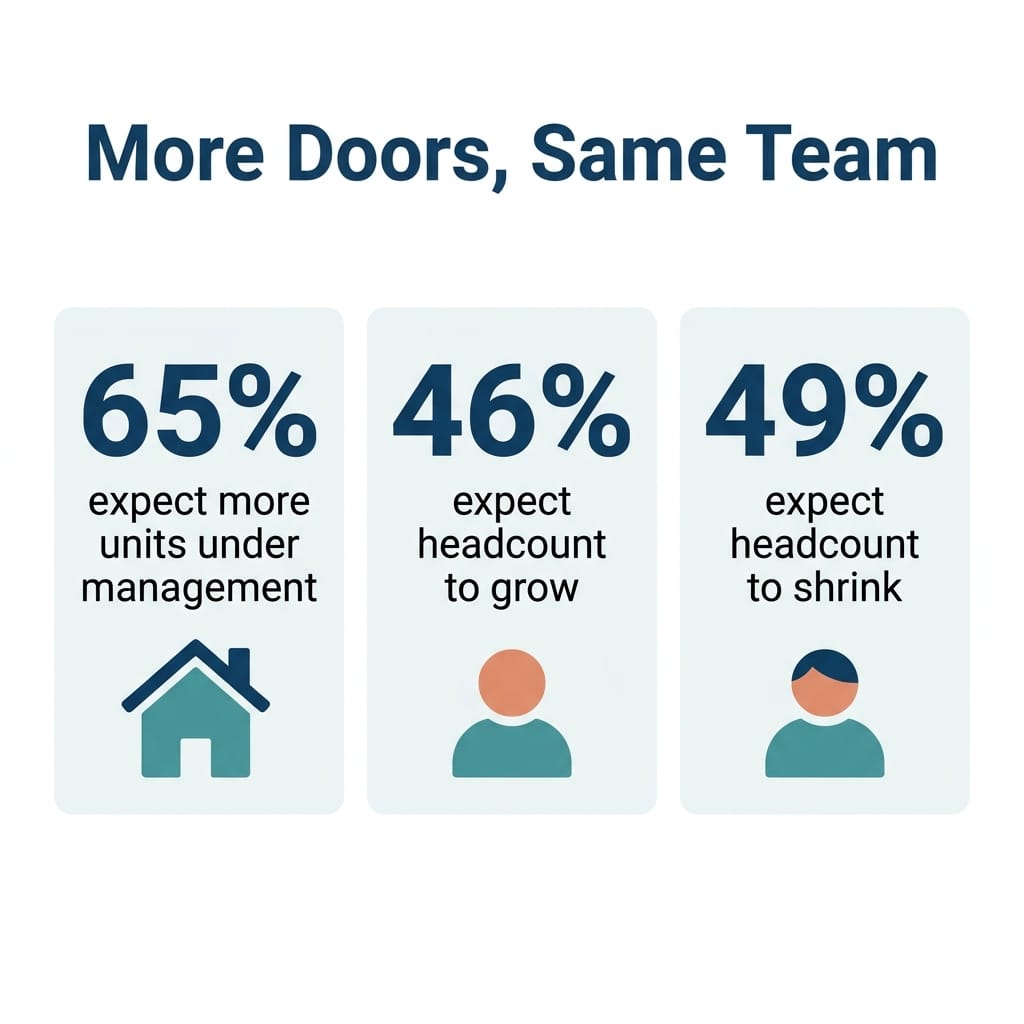
Many firms are already planning this way. The National Apartment Association reported on a 2025 industry benchmark survey. In it, 65% of property management professionals expected their units under management to grow that year. Only 46% expected headcount to grow, and 49% expected it to shrink. More doors, same or smaller team.
It doesn't have to mean layoffs. One management team NAA profiled centralized its work and chose not to refill roles as people left or got promoted. An operator in the same piece made the point well. Centralizing isn't about removing people. It is about removing friction and duplicated work, so staff can focus on residents instead of paperwork.
The work that usually forces a hire happens off the clock. Answering emergencies after hours is part of a manager's job. That is the first thing to hand off.
Automate | Hand off to our team and local agents | Keep in-house |
|---|---|---|
Rent collection, autopay and reminders | After-hours and weekend repair calls | Owner relationships |
Late fees, applied automatically | Repair coordination with vendors | Approvals on repairs and spending |
Listings to many rental sites | Showings | Final screening decisions |
Renewal reminders and e-signed leases | Inspections | Lease terms and renewal offers |
Bookkeeping with bank sync | Key handoffs and local-court coordination | Your standards, templates and rules |
Pick the plan that matches what you want off your plate:
- Starter: free. Tenant screening, rental accounting and listing to major websites.
- Basic: $30/mo (incl. $28 platform fee). Adds lease tracking, document storage, rent collection and tenant messaging.
- Essential: $48/mo (incl. $28 platform fee). Adds a dedicated repair coordinator, 24/7 emergency support and state-specific lease documents.
- Complete: $86/mo (incl. $28 platform fee). Adds a property management assistant, access to a vetted repair network and VIP support.
Service add-ons cover tenant placement, inspections and eviction assistance.
When is a hire still right? When the work left over is relationship work. If owner calls, approvals and new-client meetings fill your week, that is a person's job. Software and handoffs clear the rest, so that hire spends their time growing the business.
Whether you manage one unit or 250, you get full-service operations without building a full team. We support over 20k rental properties in 4,418 cities across the United States. Users give us 4.8 stars on Capterra, GetApp and Software Advice. See how local agents and our central platform split the work across all 50 states.
Manage your rentals on Hemlane


How can property managers give owners transparency into their rentals?
Send owners the same core numbers every month, before they ask. That means money in, money out, repairs and their status, occupancy and lease dates. Add a year-end rent summary. Pull it all from one set of records so the report matches the bank. Owners who can see their rental rarely start shopping for a new manager.
Your owners shouldn't have to chase you for a number. Regulators already set a baseline. Take Oregon as one state's example. Managers there must tell owners in writing when money moves on their ledger. Under the Oregon Real Estate Agency's rules, one monthly report does the job. It lists all money in and all money out for the prior month. Oregon also requires the management agreement to describe the monthly statements the manager will provide. Other states set their own rules, so check yours.
Money is only part of it. Managers are expected to report to owners from time to time on the property's status, occupancy and lease expiration dates. At year end, the IRS instructions for Form 1099-MISC say the property manager must use that form to report rent paid over to the owner. Ask a tax professional how this applies to you.
Here is a simple playbook.
What owners want to see | How often to share it | Where it comes from on Hemlane |
|---|---|---|
Receipts and disbursements | Monthly | Rental accounting with bank sync and a cash flow report |
Income and expenses by property | Monthly, with year to date | Income statement, plus the QuickBooks integration |
Repair requests and their status | As big jobs happen, with a monthly summary | Repair tracking with real-time status, from tenant request to vendor work order |
Occupancy and upcoming lease expirations | Monthly or quarterly | Tenant records in one place, with early renewal reminders |
Leases, invoices and key documents | On request | Document storage |
Year-end rent reporting | Yearly | Your full-year accounting records |
On Hemlane, 100% of rent goes directly to the owner. Owners keep full visibility into their financials and their properties. All of the control, none of the chaos. A clean money trail is what makes the report easy to send.
This is general information, not legal or tax advice.
How do owner distributions work in property management software?
In the classic model, rent lands in the manager's trust account. It clears. Fees and approved expenses come out. Any reserve stays. The owner gets what is left, which is why payouts lag rent day. On Hemlane, rent goes straight to the owner's bank account in 2 to 3 business days. Your state and your agreement decide which model you can use.
Owners ask two questions. When do I get paid? Why is it less than the rent? Walk them through the money one step at a time. The rules below come from specific states. They are examples, not national law.
- The tenant pays. Rent arrives electronically or by another method the lease allows.
- The deposit clears and is verified. In Oregon, a manager can't pay out funds based on a wire or electronic transfer until the deposit is verified. This is the main reason owners wait past rent day.
- The money stays separate. The National Association of Residential Property Managers code of ethics says members must hold funds received for others according to law. They must never mix those funds with personal or other business money. Oregon goes further. A manager who holds security deposits must keep them in an account separate from the clients' trust account.
- Fees and approved expenses come out. In Oregon, managers pay themselves earned fees from the trust account at least once a month, unless the agreement sets another schedule. They can only do it if the funds are there.
- The owner's ledger is checked. Oregon bars any payout unless the ledger being charged has enough money in it. In a month with a big repair, the owner may get nothing. They may even need to add funds.
- Any reserve is held. Many agreements keep a cushion for repairs. The agreement sets the amount.
- The owner receives the net, and the books close. Oregon requires each clients' trust account to be reconciled within 30 calendar days of the bank statement date.
Net or flat? A net payout sends the owner whatever is left after that month's fees and expenses. It moves up and down. A flat payout sends a set amount each month, as the agreement allows, and the balance stays on the owner's ledger. Spell out which one you use in the agreement. Then the payout never surprises anyone.
Trust account or direct to owner? Some states allow another path. Under Arizona law, a broker's trust account is required for all of the owner's money. The exception is when the owner directs the broker to deposit it straight into the owner's own account. Not every state works this way. Check your state's rules before you change how rent flows.
On Hemlane, rent is deposited directly to the owner's bank account in 2 to 3 business days. ACH payments cost $0, and 100% of rent goes to the owner. The number on the lease is the number that lands in the account. Repairs are invoiced and paid with no markups, so each cost shows up on its own.
This is general information, not legal advice. Confirm your setup with a qualified attorney or your state's real estate regulator.
What does Hemlane take off your plate?
We take the load and leave you the decisions. Software runs rent, reminders, listings, renewals and the books. On the Essential and Complete plans, our 24/7 Repair Coordination team picks up the after-hours calls. Licensed local agents handle showings, inspections, key handoffs and local-court coordination. You call the shots on owners, approvals and who gets the keys.
One login. One team. One place where an owner's numbers stay straight. We're real people behind good software, and we'd like to help you add doors without adding chaos.
Get started with Hemlane
Hemlane, Inc. is a technology company that helps you manage your long-term rental properties. Communications between you and Hemlane are protected by our Privacy Policy. Hemlane also provides access to independent licensed professionals and self-help services at your specific direction. We are not a property management firm. We cannot make any decisions on behalf of any property owners. Any content found in the Hemlane Academy is not a substitute for advice and ideas from a qualified legal source or expert. You are responsible for performing additional research to confirm you are complying with all laws applicable to your rental situation.
Frequently Asked Questions
Can property managers charge owners a markup on maintenance?
Only if the owner knows and agrees, and your state allows it. NARPM's code of ethics says members can accept no profit, rebate or other benefit the client hasn't been fully told about and approved. The National Association of REALTORS® code says the same about profit on spending made for a client. The client must know and consent. In Oregon, the management agreement must list every fee, rebate, discount, override and other pay the manager will receive, plus when it is earned and paid. Rules differ by state, and this isn't legal advice. On Hemlane, repairs are invoiced and paid with no markups. Single-use cards are available for paying service professionals.
Do late fees go to the owner or the property manager?
It depends on your management agreement. There is no industry standard. Who keeps late fees has long been a point owners and managers negotiate. Some managers pass late fees to the owner as income but still take their percentage fee on them. State law can also limit the fee itself. Colorado, for example, bars charging a tenant a late fee unless it is disclosed in the rental agreement. On Hemlane, late fees are applied automatically, and 100% of late fees go directly to the owner.
How many units can one property manager handle with software?
There is no settled number. For at least 20 years, many in the apartment industry treated one onsite team member per 100 units as the standard. One author writing for NAA argues for 1 per 45 to 61 units instead. AppFolio, a property management software company, puts the U.S. average at 54 rental units per property management employee. That varies a lot by market. Salt Lake City averaged just 35. The onsite ratios come from apartment communities, so they don't map neatly to scattered single-family homes. Your real ceiling depends on how much work you move off your desk. Handing after-hours calls to 24/7 Repair Coordination on the Essential and Complete plans, and in-person work to local agents, is what stretches it. Whether you manage one unit or 250, you get full-service operations without building a full team.
Sources


- U.S. Census Bureau — Housing Vacancies and Homeownership - Press Release · retrieved November 3, 2026
- Oregon Administrative Rules (Oregon Real Estate Agency), via oregon.public.law — OAR 863-025-0055 – Owner Ledger · retrieved November 3, 2026
- Internal Revenue Service — Instructions for Forms 1099-MISC and 1099-NEC (12/2026) | Internal Revenue Service · retrieved November 3, 2026
- National Association of Residential Property Managers — Code of Ethics and Standards of Professionalism for the National Association of Residential Property Managers - National Association of Residential Property Managers · retrieved November 3, 2026
- Arizona State Legislature (A.R.S. 32-2174) — 32-2174 - Property management accounts; trust accounts; signatories · retrieved November 3, 2026
- Property Meld — The Undeniable Link Between Maintenance and Lease Renewals · retrieved November 3, 2026
- Multifamily Executive — Kingsley: Renter Satisfaction Holds Steady, Renewal Intent Drops Slightly · retrieved November 3, 2026
- U.S. Bureau of Labor Statistics — Property, Real Estate, and Community Association Managers : Occupational Outlook Handbook: : U.S. Bureau of Labor Statistics · retrieved November 3, 2026
- Oregon Administrative Rules (Oregon Real Estate Agency), via oregon.public.law — OAR 863-025-0020 – Property Management Agreements · retrieved November 3, 2026
- National Apartment Association — Centralization: How Property Managers Optimize Operations | National Apartment Association · retrieved November 3, 2026
- National Apartment Association — From Flat Rents to AI Adoption: The 2025 AppFolio Property Management Benchmark Report Reveals Key Trends | National Apartment Association · retrieved November 3, 2026
- Cornell Law School Legal Information Institute (Oregon Admin. Code 863-025-0025) — Or. Admin. Code § 863-025-0025 - Clients' Trust Account and Security Deposits Account Requirements | State Regulations | US Law | LII / Legal Information Institute · retrieved November 3, 2026
- National Association of REALTORS® — Disclose Your Ownership Interest · retrieved November 3, 2026
- Inman — Property manager's right to keep late fees questioned | Inman Real Estate News · retrieved November 3, 2026
- Colorado General Assembly — SB21-173 Rights In Residential Lease Agreements | Colorado General Assembly · retrieved November 3, 2026
- National Apartment Association — Changing the Paradigm of Staffing Ratios | National Apartment Association · retrieved November 3, 2026
- AppFolio — Quarterly Market Update: Examining the Factors That Influence Property Manager Service Levels · retrieved November 3, 2026
Get the Latest in Real Estate & Property Management!
I consent to receiving news, emails, and related marketing communications. I have read and agree with the privacy policy.


