
Rental Management Software: Collect Rent, Keep Every Dollar

Editorial Staff
Content published by Hemlane is created and reviewed by members of our editorial team, including experienced technical writers and real estate professionals.
Rent day should be quiet. Often it isn't.
A tenant forgets. A fee eats part of the payment. A bank transfer comes back after you thought it cleared. Then you're texting, waiting and wondering what your state lets you do next.
This guide follows one rent payment from start to finish. How the money moves. Who pays to move it. How reminders and late fees back it up. What to do if it bounces. You call the shots at every step. The goal is simple: set it up once, and set it up right.
How does online rent collection work in rental management software?
You link a bank account and set the rent from the lease. The tenant gets an invite, picks a way to pay or turns on autopay, and the money moves between banks. It shows as pending first. Then it confirms and lands in your account. Your books update on their own.
Here is the full path, from your side and the tenant's.
- You link your bank account and set the lease charges. Rent amount, due date and any fees the lease allows. This is what the software will ask for each month.
- You invite the tenant. They create a login and connect a way to pay.
- The tenant pays once or sets up autopay. Autopay needs the tenant's OK. Under Regulation E, a recurring debit from a personal account must be authorized in writing or a similar signed form, and the tenant gets a copy. You can read the rule on the Consumer Financial Protection Bureau's Regulation E page. Autopay is not a lock. A tenant can stop a scheduled debit by telling their bank at least three business days before it runs.
- The money moves between banks. Bank payments run on the ACH network. Nacha, which sets the rules for that network, names two operators that route them: the Federal Reserve and The Clearing House. In a rent debit, the tenant's bank pulls the money from the tenant's account.
- It shows as pending. Bank payments confirm late. The tenant's bank doesn't answer yes or no right away. At one major processor, confirmation can take up to 4 business days.
- It confirms or fails. A bank payment isn't guaranteed. It can still fail, and a tenant can dispute it.
- It deposits. On Hemlane, rent goes directly to your bank account in 2 to 3 business days.
- Your books update. The payment posts to the ledger, so your reports match your bank.
Pending is not paid. Wait for the payment to confirm before you spend it.
One tax point. Payment platforms may report the rent they process on Form 1099-K. The Internal Revenue Service explains in its Form 1099-K threshold FAQ that a platform isn't required to file one unless payments to you top $20,000 and the number of transactions tops 200. Whether or not a form arrives, talk to your tax pro about how to report your rent.
On Hemlane, tenants pay by ACH, card or Cash App. Autopay and payment reminders are built in. Full rental accounting comes with it: bank sync, cash flow report, income statement and more. We've processed $1.8B in payments. Rent collection starts on the Basic plan at $30/mo (incl. $28 platform fee), priced per unit monthly after a 14-day trial. That plan also adds lease tracking, document storage and tenant messaging.
See our rent collection tools and payment methods. Or see how rent sits next to leasing and repair coordination on one platform with local support. One login. One team. No patchwork.
Get started with Hemlane
Who pays the processing fees on online rent payments?
Someone always pays to move money. The only question is who. There are three models: the owner pays, the tenant pays, or the cost is split by payment method. Bank payments cost far less to process than cards. State law can limit what you pass on, so check yours before you pick a model.
Start with the price of moving money. As a benchmark, Stripe's standard US rates as of October 2026 were 2.9% + 30¢ for cards and 0.8% capped at $5 for ACH bank debits. That is one processor's public price list, not a Hemlane price. But the shape holds. A card fee grows with the rent. A bank fee at those rates stops at $5.
Payment method | If the owner pays | If the tenant pays | One way to split | Watch out for |
|---|---|---|---|---|
ACH bank transfer | Lowest cost to absorb. Rent arrives whole. | A small fee can push tenants back to paper checks. | Owner covers bank payments. | Some states require at least one fee-free way to pay. |
Debit card | Costs more than a bank payment. | Card network rules can bar the surcharge. | Owner absorbs it or steers tenants to bank payments. | Mastercard bars surcharges on its debit and prepaid cards. |
Credit card | Highest cost. It grows as rent grows. | Tenant pays for the convenience. | Tenant covers card fees. | Network caps and state limits on passing costs along. |
The law changes the answer by state. A few real examples:
- Colorado bars rent processing fees unless the tenant has at least one fee-free way to pay. If your online portal is the only option, you absorb the cost or build it into the advertised rent.
- Virginia bars processing fees above the actual third-party cost. Owners must also keep at least one way to pay with no added fee.
- California bars charging a tenant a fee for paying rent or a security deposit by check.
- Card networks set their own limits. Mastercard's merchant surcharge rules bar surcharges on Debit Mastercard and prepaid cards and cap surcharges at 4%. That cap is Mastercard's. Other networks write their own rules.
These are examples, not a national rule. Check your own state and city.
Fees also shape behavior. A tenant who sees a charge at checkout has a reason to mail a check instead. Then you're back to chasing paper.
Here's where we stand. We charge $0 ACH fees. Every late fee, 100% of it, goes to you. What the lease says is what reaches your account. Tenants pay by bank with $0 ACH fees too. Our plans run from a free Starter plan to Basic at $30/mo (incl. $28 platform fee), Essential at $48/mo (incl. $28 platform fee) and Complete at $86/mo (incl. $28 platform fee). The money other platforms take in ACH fees stays yours.
Manage your rentals on Hemlane
Do automated rent reminders reduce late payments?
They help, but only with one kind of late. A nudge catches the tenant who can pay and simply forgot. It can't create money that isn't there. Use reminders to catch the forgetful payments. Then let autopay and a clear late-fee policy, written into the lease, handle the rest.
The best evidence comes from credit cards, not rent. In one study of overdue credit card holders, a digital reminder raised repayment for people with high credit scores. It did little for people with lower scores. Overall, 64.3% of those who got the reminder paid off everything they owed that cycle, against 61.9% who didn't. That's 2.4 percentage points. Real, but small.
Rent looks similar. Survey data on U.S. households shows nearly one in four renters earning under $100,000 fell behind on rent at some point in the prior year. For renters earning $100,000 or more, it was 6%. Many late payments come from a tight month, not a bad memory. No reminder fixes that.
So time your reminders to lead somewhere.
When | What it does | What it leads into |
|---|---|---|
A few days before the due date | A friendly heads-up with the amount and date. | An invite to set up autopay. |
On the due date | Confirms the payment or prompts one. | A check that the payment shows as pending. |
End of the grace period | States that the late fee posts under the lease. | The late-fee notice and a personal call. |
Match the days to your own lease. The grace period is yours to set, within your state's rules.
Worried a reminder makes you a debt collector? Under the federal Fair Debt Collection Practices Act, a debt collector is generally someone who regularly collects debts owed to others. An owner reminding a tenant about the owner's own rent generally falls outside that. State debt-collection laws can differ, so check yours.
One autopay rule to know. If an autopay debit changes in amount, the tenant must get written notice of the amount and date at least 10 days before it runs. That matters the moment a late fee or a rent change rides on autopay.


Hemlane's rent collection includes payment reminders and autopay. Tenant Perks helps tenants build credit, and tenants can earn rewards for paying on time. A tenant who gains something from paying on time has one more reason to do it.
How should owners set up late fees in rental management software?
Start with the lease and your state's law, not the software. Decide the fee type, amount, cap, grace period and what the fee applies to. Write it into the lease. Only then switch it on in the software, and apply it to every tenant the same way. The setting enforces your policy. It doesn't make it legal.
Work through it in this order:
- Confirm the lease and your state's rules. Your lease has to allow the fee. Your state may limit it.
- Choose a flat or percentage fee. A flat fee is easy to read. A percentage moves with the rent.
- Set the amount and any cap. Use what your state allows, not a number copied from somewhere else.
- Set the grace period and the posting day. Decide the exact day the fee posts, and put it in writing.
- Decide what charges it applies to. Some states draw a hard line here. Colorado, for example, bars late fees on anything other than rent itself.
- Set tenant notice. Tell tenants how the fee works before it ever posts. If a late fee will change an autopay debit, the 10-day written notice rule above applies.
- Apply it to every tenant the same way. Same fee, same timing, same terms.
- Record any waiver. If you waive a fee, note when and why. A clean record protects you later.
This checklist helps you organize the decision. It isn't legal advice. Confirming the rules for your state stays with you.
Hemlane applies automatic late fees once you set your policy. 100% of every late fee goes to you. Our lease management builds state-specific leases with e-signatures, so the fee is spelled out before the tenant moves in. State-specific lease documents come on the Essential plan at $48/mo (incl. $28 platform fee), along with a dedicated repair coordinator and 24/7 emergency support.
What should owners do when a tenant's online rent payment bounces?
Don't panic, and don't spend it. Find out why it came back, then reach the tenant. Agree on a fix and a date. Retry only with a plan, since a bounced debit can be retried just a limited number of times. Then check what your state lets you require next. A process beats a scramble.
A bounce feels like the first step toward losing the rent. Usually it's a slip you can fix. Here's how big it really is.
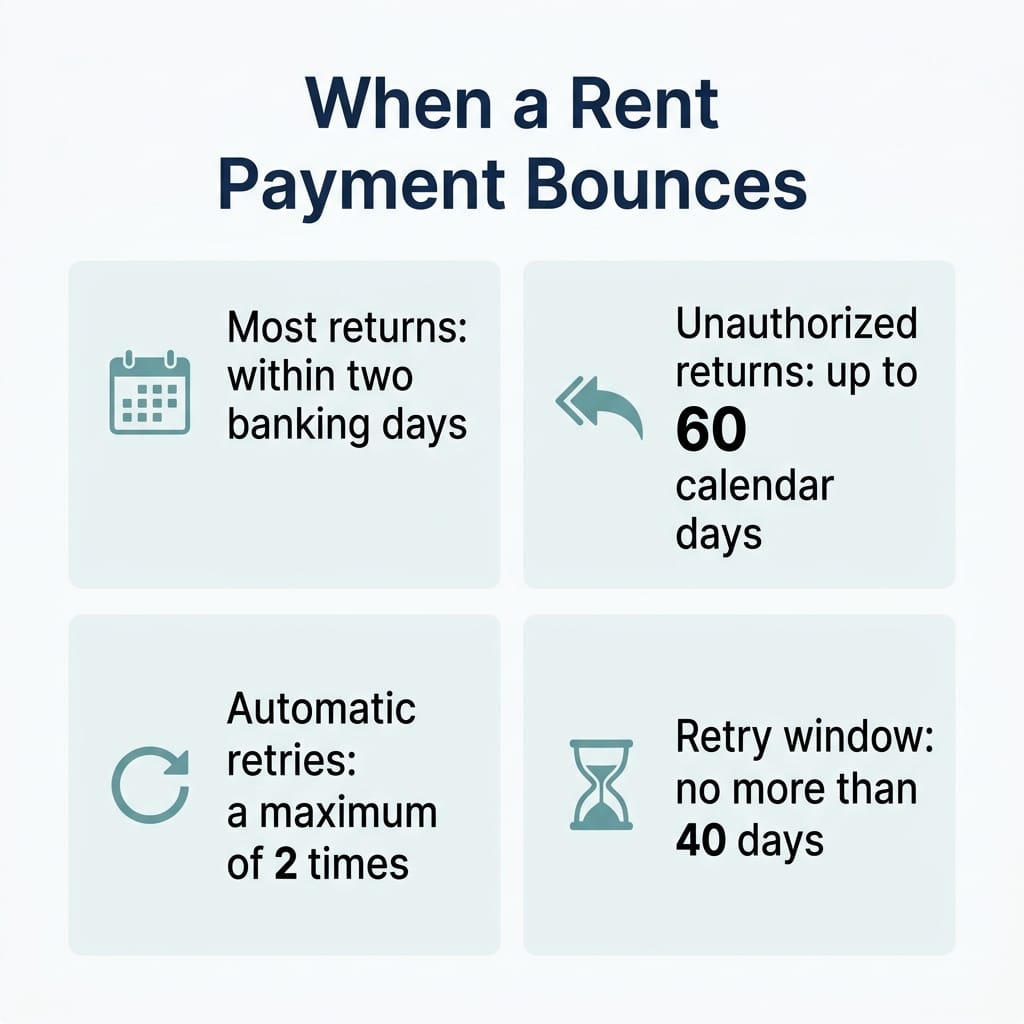
When returns show up. Most come back fast. Bank rules say the common returns, including insufficient funds, must be sent within two banking days of settlement. Returns for unauthorized debits can come back up to 60 calendar days later on a personal account. A tenant can generally dispute a personal-account debit with their bank for up to 60 calendar days.
What the reason means. Two codes cover most short-money returns. R01 means the balance was too low. R09 means the money is there but on hold, waiting to clear. The second one can mean the rent is on its way, just not yet.
How often you can retry. Not often. One bank says it will retry a debit returned for insufficient or uncollected funds no more than two times. One processor caps automatic retries at 2, within 40 days of the first try. Every retry counts, so don't waste one.
Your plan, step by step:
The first 24 hours
- Check the return reason.
- Leave the money unspent and note the return on the ledger.
- Reach the tenant by phone or message. Ask what happened. Keep it calm and short.
The following week
- Agree on a fix: a retry date, or another way to pay.
- Retry only after the tenant confirms the money is there.
- Check your state's rules. In Virginia, since July 1, 2026, a 14-day period applies when a check or electronic payment is rejected for insufficient funds. The tenant can cure with cash, a cashier's check, a certified check or a completed electronic transfer. In California, if a tenant's check bounced for insufficient funds or they stopped payment on a check, draft or money order, an owner may require cash only for up to three months. These rules belong to those states. Yours may differ.
- Apply a late fee only as your lease and state allow.
After repeat bounces
- Look at the pattern. Is it the same reason each time?
- Ask for a different way to pay, where your state allows it.
- Step in early, in writing, before the balance grows.
A first bounce may be a timing slip. Treat it like one. A second or third is a pattern. Treat that like one too: earlier, and on the record.
If late rent turns into real delinquency, court isn't the only path. Court costs money, takes time and has no certain outcome. Hemlane's Eviction Shield handles delinquency with early intervention and mediation, built to resolve things before anyone files. The goal is to skip court costs and keep the tenancy working. See our eviction support.
Frequently Asked Questions
Can owners require tenants to pay rent online?
It depends on your state and city. Some states require you to accept other ways to pay. California requires that a tenant can pay by a method other than electronic transfer or cash. One California law firm reads that as allowing an owner to require electronic transfer or a cashier's check. Virginia requires owners to accept check and money order alongside online payments, and a tenant can't be limited to one portal that rules those out. In Colorado, a required portal may need to be fee-free, since processing fees are barred unless the tenant has at least one fee-free option. Hemlane tenants can pay by ACH, card or Cash App, but those are all electronic. Check your own state's rules before you write online-only into a lease. This is general information, not legal advice.
How long does it take for online rent payments to reach an owner's bank account?
On Hemlane, rent is deposited directly to your bank account in 2 to 3 business days. Across the banking network, an estimated 80% of ACH payments settle in one banking day or less. Bank debits also can't be dated more than one banking day ahead, so each payment starts close to its date. Processors add their own confirmation time, up to 4 business days at one. Ask any platform how its first payout works. At one major processor, a first payout typically lands 7 to 14 days after the first live payment. Weekend and holiday payouts arrive the next business day. And received isn't final. Most returns come back within two banking days of settlement, while unauthorized returns on personal accounts can take up to 60 calendar days. Leave a cushion between rent day and your mortgage.
Is it safe for owners to link their bank account to rental management software?
No platform is risk-free, but you can check the right things. Ask how your bank data is encrypted. Some bank-connection providers describe standards like AES 256 and TLS. Ask whether the platform shares your data without permission or sells your financial information. Know that the ACH network now asks more of everyone in it. Under new rules phased in during 2026, every business, bank and payment platform on the network must screen payments for fraud. Keep rent in a separate account. Tax guidance for businesses says to keep a business account apart from your personal checking. Watch your statements. On a personal account, you must report an unauthorized transfer within 60 days of the statement to avoid liability for later ones. If you spot fraud, the Federal Trade Commission's advice on what to do if you were scammed is to report it to your bank right away. Business accounts move faster: at one processor, a business-account debit can be disputed for only two business days. Hemlane's rental accounting includes bank sync, so your books follow your bank without extra logins.
Set it up once. Set it up right. Then let the rent come to you. You call the shots, we handle the rest.
Get started with Hemlane
Hemlane, Inc. is a technology company that helps you manage your long-term rental properties. Communications between you and Hemlane are protected by our Privacy Policy. Hemlane also provides access to independent licensed professionals and self-help services at your specific direction. We are not a property management firm. We cannot make any decisions on behalf of any property owners. Any content found in the Hemlane Academy is not a substitute for advice and ideas from a qualified legal source or expert. You are responsible for performing additional research to confirm you are complying with all laws applicable to your rental situation.
Sources


- Consumer Financial Protection Bureau (Regulation E §1005.10) — § 1005.10 Preauthorized transfers. | Consumer Financial Protection Bureau · retrieved November 3, 2026
- Nacha — HOW ACH PAYMENTS WORK | Nacha · retrieved November 3, 2026
- Internal Revenue Service — IRS issues FAQs on Form 1099-K threshold under the One, Big, Beautiful Bill; dollar limit reverts to $20,000 | Internal Revenue Service · retrieved November 3, 2026
- Mastercard — Mastercard Credit Card Surcharge Rules and Fees for Merchants | Mastercard US · retrieved November 3, 2026
- Federal Trade Commission — What To Do if You Were Scammed | Consumer Advice · retrieved November 3, 2026
- IDEAS/RePEc (Campbell, Grant & Thorp, Journal of Banking & Finance) — Reducing credit card delinquency using repayment reminders · retrieved November 3, 2026
- Board of Governors of the Federal Reserve System — The Fed - Report on the Economic Well-Being of U.S. Households in 2024 - May 2025 - Housing · retrieved November 3, 2026
- Consumer Financial Protection Bureau — Debt collection key terms | Consumer Financial Protection Bureau · retrieved November 3, 2026
- Stripe — ACH Direct Debit payments | Stripe Documentation · retrieved November 3, 2026
- Coakley Law (Colorado law firm) — Colorado Price Transparency Law for Landlords | Coakley Law · retrieved November 3, 2026
- Plaid — ACH return codes: A complete guide for businesses | Plaid · retrieved November 3, 2026
- Cross River Bank — CRBT › ACH Origination Rule Change · retrieved November 3, 2026
- Cox, Castle & Nicholson LLP — California Law Limits Landlords’ Right to Require Their Tenants to Pay Rent Electronically · retrieved November 3, 2026
- Williams Mullen — Virginia Enacts New Laws Impacting Residential Landlords | Williams Mullen · retrieved November 3, 2026
- Paycove — Stripe fee calculator — Paycove · retrieved November 3, 2026
- Robinson & Henry, P.C. — Surviving Colorado’s Junk Fees Law: A Landlord’s Guide · retrieved November 3, 2026
- first tuesday Journal — New law takes aim at “junk fees” from California landlords | firsttuesday Journal · retrieved November 3, 2026
- Stripe — Receive payouts from Stripe | Stripe Documentation · retrieved November 3, 2026
- Plaid — Trust and Safety | Plaid · retrieved November 3, 2026
- Nacha — New Nacha Risk Management Rules Now in Effect | Nacha · retrieved November 3, 2026
- Internal Revenue Service (Publication 583) — Publication 583 (12/2024), Starting a Business and Keeping Records | Internal Revenue Service · retrieved November 3, 2026
- Consumer Financial Protection Bureau (Regulation E §1005.6) — § 1005.6 Liability of consumer for unauthorized transfers. | Consumer Financial Protection Bureau · retrieved November 3, 2026
Get the Latest in Real Estate & Property Management!
I consent to receiving news, emails, and related marketing communications. I have read and agree with the privacy policy.


