
Tenant Management Software: A Practical Guide for Owners

Editorial Staff
Content published by Hemlane is created and reviewed by members of our editorial team, including experienced technical writers and real estate professionals.
A rent sheet in Excel. A phone full of tenant texts. A lease in a folder somewhere. A receipt in the glovebox. Most owners run their rentals this way for years. It works, until one day it doesn't.
This guide treats tenant management as the daily work it is. You'll see where a spreadsheet still fits. You'll see what to hand to software as you add doors. And you'll get plain rules for tenant messages, noise complaints, official notices and records.
You make every call. The tools just carry the load.
Can you use Excel instead of tenant management software?
Yes, for a while. A spreadsheet can track rent, expenses and lease dates for a few doors, and it costs nothing. What it can't do is collect rent, screen an applicant, list a vacancy or give tenants one place to reach you. Those gaps get wider with every door you add.
What a spreadsheet does well
Give the spreadsheet its due. It's free. You built it, so you know every column. It bends to fit how you work. For one or two doors with steady tenants, it may be all you need.
Where a spreadsheet carries risk
Three risks sit inside every rent ledger kept by hand.
Formula errors. One study of spreadsheets used in business decisions found that 94% of them contained errors. That research wasn't about rentals. But a rent ledger is a business spreadsheet. One broken formula can hide a missed payment. Or a late fee you never charged.
No tenant side. A spreadsheet is yours alone. Tenants can't pay in it. They can't send a repair request or check a balance. So every update reaches you by text or call, and you type it in.
Data security is on you. Applications hold income, bank details and ID numbers. The Federal Trade Commission's guide to protecting personal information tells businesses to keep only what they need. It also says to properly dispose of what they no longer need. In a spreadsheet, you do both by hand. That includes every copy in email, on a laptop and on a thumb drive.
Tracking people through a process is its own job, too. Software built to follow a contact from first inquiry to final deal goes far beyond what a spreadsheet can do. For an owner, that contact is a renter. They go from listing view to application to signed lease.
Excel against software, task by task
Task | A spreadsheet | Tenant management software on Hemlane |
|---|---|---|
Rent collection | Records rent after it arrives. Can't collect it. | Online rent collection from the Basic plan, with $0 ACH fees. |
Rent ledger and late fees | Works if every formula works. Late fees are tracked by hand. | Rental accounting with bank sync, free on Starter. When you collect rent on Basic, 100% of late fees go to you. |
Expense tracking | Strong here, if you enter every receipt. | Bank sync, a cash flow report and an income statement, free on Starter. |
Tenant records and documents | Cells point to files stored somewhere else. | Lease tracking and document storage from Basic. |
Maintenance requests | Arrive by text. You log each one yourself. | A dedicated repair coordinator and 24/7 emergency support on Essential. |
Tenant communication | None. Messages live in your phone. | Tenant messaging from Basic, in one thread per conversation. |
Screening | Can't run a report. You buy and store reports elsewhere. | National credit, criminal, eviction and income reporting, free on Starter. |
Listing a vacancy | Can't post anywhere. | Listings on Apartments.com, Zillow and 7 more top websites, free on Starter. |
Data security | Every file and every copy is yours to protect and delete. | Records sit in one account, not scattered copies. You still decide what to keep. |
Signs you've outgrown the spreadsheet
There's no magic number of doors. In our view, these signs say the spreadsheet has done its job:
- You charged a late fee late, or not at all, because the sheet didn't flag it.
- You scroll through texts to prove what a tenant said.
- Applications pile up in your email inbox.
- A vacancy means posting the same listing on site after site.
- You add a new column every month to cover something new.
- Someone else needs access, and you're emailing the file back and forth.
The cost argument
Cost is the best case for Excel. It's also the easiest one to answer. Our Starter plan is free. It includes tenant screening, rental accounting and listing to major websites. Rent collection, tenant messaging and document storage start on Basic.
Software handles the admin. People handle what software can't. See how our platform and licensed local agents work together on our nationwide property management page.
Get started with Hemlane
How does tenant management software help owners scale beyond a few units?
Software takes over the admin that grows with each door: rent, renewals, records and listings. It can't fix a burst pipe or open a door for a showing. Growing without hiring staff means pairing software with people for that work. You keep every decision and every dollar on the lease.
Growth is where owners who manage their own doors start to thin out. National survey data shows individual investors own 58.8% of rental homes in buildings with two to four units. In buildings with 5 to 24 units, that share drops to 19.2%. At 50 units or more, it's just 4.6%. Bigger buildings tend to have bigger operators behind them.
You don't need to become one to grow. You need to know what breaks first.
What breaks at each stage, and what fixes it
Stage | What breaks first | What fixes it | Software or person |
|---|---|---|---|
A handful of doors | Chasing rent by text and checking the bank | Online rent collection with $0 ACH fees. 100% of late fees go to you. | Software |
A handful of doors | Filling a vacant unit fast | Listings on major websites plus screening, free on Starter | Software |
A growing portfolio | Lease renewals slip past their dates | Renewal reminders before a lease ends | Software |
A growing portfolio | The 2 AM repair call stops being rare | A dedicated repair coordinator and 24/7 emergency support on Essential | Person |
A growing portfolio | Leases copied from old templates | State-specific lease documents on Essential | Software |
Other cities or states | Showings, inspections and key handoffs you can't do yourself | Licensed local agents. Tenant placement and inspections are add-on services. | Person |
Other cities or states | Finding repair vendors you trust in a new town | Access to a vetted repair network and a property management assistant on Complete | Person |
What each plan costs
As of November 2026, Starter is free. Basic is $30/mo, Essential is $48/mo and Complete is $86/mo. Each paid plan includes a $28 platform fee.
Pick the tier that fixes the bottleneck you have now. Move up when the next one shows.
Built for growth, backed by people
Our lease management handles portfolios from 1 to 2,000 units. We support over 20k rental properties in 4,418 cities, across all 50 states. We've completed 61,218 service requests. Users rate us 4.8 stars on Capterra, GetApp and Software Advice.
Software can't stand in a driveway, though. That's where local agents come in. Philip Rooss of Ready Rent, for example, covers in-person work for multifamily buildings of 5 to 15 units in Santa Clara, San Mateo and San Francisco counties.
Agents in our network work at your direction. We are not a property management firm. You call the shots. We handle the load.
Manage your rentals on Hemlane
How should owners communicate with tenants through tenant management software?
Give every message a home. Everyday questions, repair requests and reminders go in one in-platform thread. Emergencies go to a phone line someone answers. Official notices go out the way your lease and your state require. Tell tenants these rules at move-in, and you stop hunting through texts for proof.
Why one thread beats a scattered phone
Texts live on one phone. Calls leave no trace. Email splits into a dozen threads.
One thread keeps every message in order, with a date and time. That protects you and your tenant. If there's a question later about who said what, you both have the same record.
Which message goes where
Message type | Where it goes | Automated or personal | Tip |
|---|---|---|---|
Rent reminders | In-platform message | Automated | Set it once. Let it run every month. |
Maintenance requests and updates | In-platform thread | Personal | Confirm you got it. Post each update in the same thread. |
Emergencies after hours | Phone to your emergency line | Personal | On Essential, our repair coordination team answers around the clock. |
Entry notices | In writing, as your lease and state require | Personal | Say when and why. Keep a copy. |
Renewal offers | A written offer | Reminder automated, offer personal | You get a reminder before the lease ends. The offer is yours to write. |
Lease violations and other formal notices | Delivered the way your lease and state law require | Personal | Never a casual text. See below. |
Formal notices are their own category
A notice of default or a right-to-cure notice isn't a chat. The federal E-SIGN Act, as published by Cornell Law School's Legal Information Institute, carves out notices of default, eviction and the right to cure under a rental agreement for someone's primary residence. Its electronic-records rules don't cover them.
So how those notices must be delivered comes down to your state's law and your lease. Check both before you send. Our messaging is for everyday talk. It isn't a stand-in for legal notice.
Set expectations at move-in
Cover four things on move-in day:
- Where to send what. Everyday messages go in the thread. Emergencies go to the phone line.
- What counts as an emergency. A gas smell, water pouring in, no heat in freezing weather.
- When to expect a reply. Pick a window you can actually keep.
- How official notices will arrive. Whatever your lease says.
When to automate and when to write it yourself
Automate what's the same every time. Rent reminders. Renewal alerts.
Write it yourself when the message is about this tenant, this problem or this home. Keep it short and specific. For example: "Got your note about the kitchen faucet. A plumber will reach out today to set a time." Or: "Thanks for the heads-up on the porch light. It's on the list for this week."
Take the 2 AM call off your plate


After-hours calls are what wear owners down. On Essential, our repair coordination team picks up, troubleshoots and dispatches around the clock. You stop taking the 2 AM call.
Tenant messaging starts on Basic, alongside rent collection, lease tracking and document storage. Leases can be signed electronically right in the platform, and every tenant record stays in one place.
How should owners handle tenant complaints about neighbors or noise?
Treat it as a process, not a fight. Get the complaint in writing and gather facts. Check what your lease says, then send a friendly reminder. Move to formal written notice only if the problem continues and the lease covers it. If the noise comes from someone who isn't your tenant, local authorities are the better path.
First, whose problem is it?
Start with who's making the noise.
- Another of your tenants. Your lease is your tool. You can act on it.
- A neighbor who isn't your tenant. You have no lease with them. Point your tenant to local noise rules, a community mediation service or the non-emergency police line.
- Any sign of danger. Your tenant should call emergency services first. Then tell you.
What your tenant can expect, often called quiet enjoyment, depends on your state and your lease. There's no single national rule.
The steps, and what to log at each one
- Ask for it in writing. Have your tenant send the complaint in the message thread. Ask what they heard, when, and how often. Log: the date, time and their own words.
- Acknowledge it. Send one short reply. Thank them and say you're looking into it. Don't promise an outcome yet. Log: your reply, in the same thread.
- Gather facts. Is this a one-off or a pattern? Have other tenants mentioned it? Talk to the other tenant too, and listen before you decide. Log: each conversation, with its date. A single complaint may never repeat. Keep the log anyway. If a second one comes, you'll want the first entry.
- Check the lease. Look for quiet hours, nuisance and guest clauses. Document storage keeps the signed lease on hand, so you're not digging for it. Log: which clause applies, if any.
- Send a friendly reminder. Write to the tenant named in the complaint. Keep it neutral. Point to the clause, not the person who complained. For example: "We've had a report of loud noise late at night. A reminder that your lease sets quiet hours in section 12." Log: the reminder and any reply.
- Give formal written notice if it continues. A lease-violation or right-to-cure notice is a regulated step. Its delivery follows your state's law and your lease, not a casual message. Essential includes state-specific lease documents. Log: a copy of the notice and proof of how it was delivered.
- Bring in mediation or local authorities. We favor early intervention and mediation over court. It keeps costs down and keeps the relationship intact. Court over noise is slow and costly, and the outcome is never certain. Talk to a local attorney before any step in that direction.
These steps are a practical guide, not legal advice. How you respond is always your call.
What tenant records should owners keep and for how long?
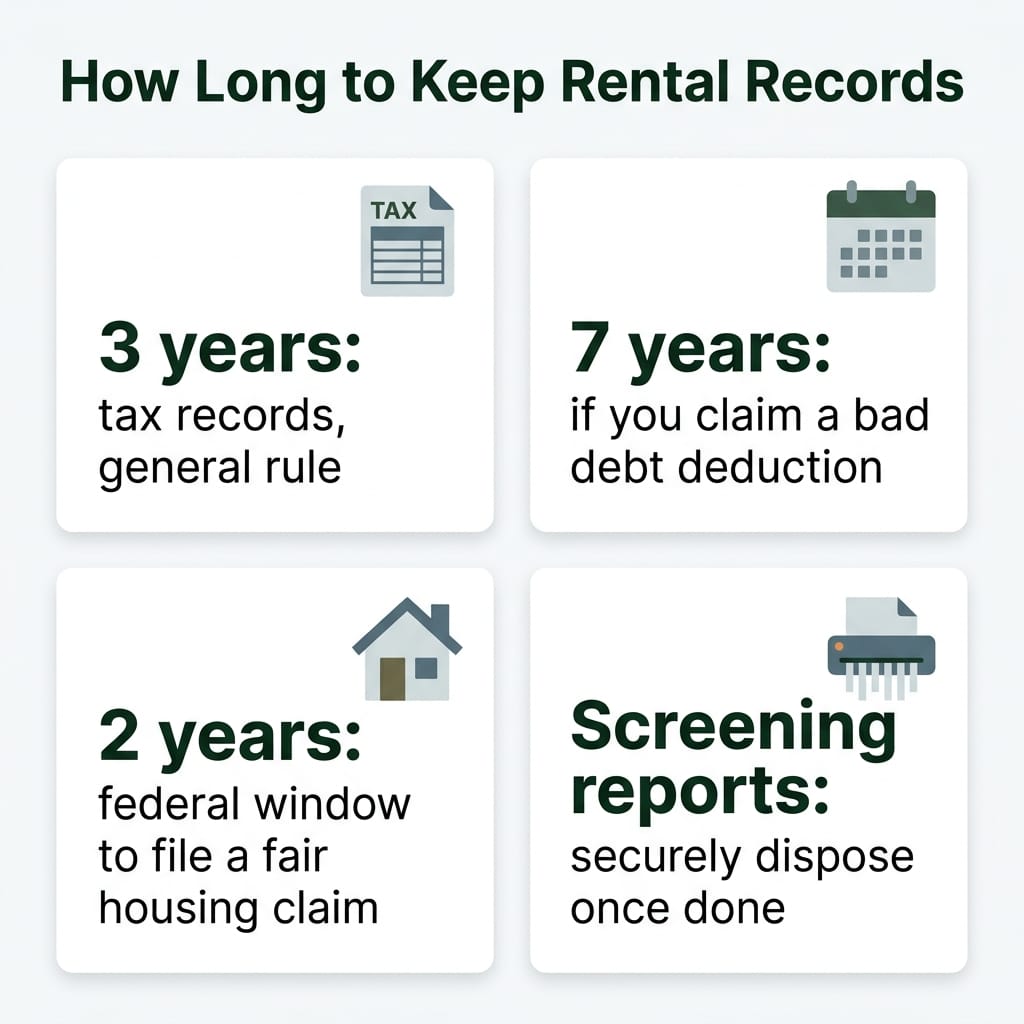
Keep tax records until the IRS can no longer question that return, which is generally 3 years. Keep property records until you sell, and beyond. Keep application decisions long enough to answer a fair housing claim. Leases, inspections and deposits follow your state's rules. Securely dispose of screening reports once you're done.
The federal rules behind the periods
Tax records. The IRS page on how long to keep records sets the principle. Keep records that support income, deductions or credits on a return until that return's period of limitations runs out. The general period is 3 years. If you claim a bad debt deduction, it's 7 years.
Property records. These stay longer. You need them to figure your basis for gain or loss when you sell.
Applications. Federal fair housing law, as published by Cornell Law School's Legal Information Institute, lets a person file a civil action up to 2 years after a discriminatory practice happened or ended. That isn't a rule telling you how long to keep files. It's a strong reason to keep application records at least that long.
Screening reports. These follow a different rule. The Federal Trade Commission's guide on using consumer reports says that once you're done using a report, you must securely dispose of it and any information you gathered from it. The FTC's disposal rule covers landlords by name. Keep a short note of what you decided and why. Shred or securely delete the report itself.
Across all of it, keep only what you need. Less sensitive data means less to protect.
Record by record
Record | Why you keep it | How long | Who sets the period |
|---|---|---|---|
Applications and screening decisions | To answer a fair housing claim | At least as long as the 2-year federal window to file one | Federal reason; check your state |
Screening reports | Used only for the decision | Until you're done using them, then securely dispose | Federal (FTC) |
Signed leases and addenda | Proof of the terms you both agreed to | Set by your state | State law |
Move-in and move-out inspections | Evidence in a deposit dispute | Set by your state | State law |
Security deposit records | Proof of deductions and the return | Set by your state | State law |
Rent ledgers and expense receipts | Support your tax return | Generally 3 years. 7 years if you claim a bad debt deduction. | Federal (IRS) |
Notices sent and received | Proof of what went out, when and how | Set by your state and lease. Keep proof of delivery. | State law |
Maintenance requests and correspondence | Show what was reported and fixed | No single federal period. Keep with the tenant's file and check your state. | State law and your judgment |
Property purchase and improvement records | Figure your basis when you sell | Until you sell, then until that year's return can no longer be questioned | Federal (IRS) |
This table is a starting point, not legal or tax advice. A tax professional and your state's rules have the final word.
Keep it findable
A rule only helps if you can find the record. Document storage, from Basic, keeps leases, notices and tenant records in one place. Rental accounting, free on Starter, keeps income and expenses organized with bank sync, a cash flow report and an income statement. Our lease management also integrates with QuickBooks.
None of that changes what the rules require. It just means the record is there when you need it.
Frequently Asked Questions
Can each tenant on a shared lease have their own tenant account?
In many rental software tools, yes. TenantCloud lets each roommate set up their own account with access to the lease and transactions. Roommates there can pay their own share or one invoice together. Rentec Direct gives co-tenants the same features whether they're added as a group or one by one.
Who owes the full rent is a separate question. That depends on your lease and your state's law, not on how the accounts are set up. If you're setting up a shared lease on Hemlane, ask our team how it works for your situation at support@hemlane.com.
Should owners send official notices to tenants by text or by email?
Not by text. By email only where your state and your lease allow it. Federal e-signature law leaves notices of default, eviction and the right to cure for a primary residence outside its electronic-records rules. That leaves the answer to your state.
Florida shows how narrow it can be. Until recently, only hand delivery or mail counted there. Now email notice is allowed only when owner and tenant both agree in writing, through an addendum to the lease. The sender must also keep a copy of the notice and proof it was sent. That's Florida's rule, not a national one.
Use tenant messaging, from Basic, for everyday talk. Use the delivery method your state requires for anything official. Essential includes state-specific lease documents.
What is a CRM in property management software?
CRM stands for customer relationship management. It's a set of tools to document, track and manage relationships with current and potential customers. It spans marketing, sales and service.
In a rental, those map neatly. Marketing is your listing. Sales is screening applicants and signing the lease. Service is everything after move-in. Tracking all three goes well beyond what a spreadsheet can do.
We don't sell a product called a CRM, and most owners don't need a separate one. Our plans cover the same ground: listing to major websites, applicant and tenant screening, tenant messaging, and every tenant record in one place.
One spreadsheet. One phone full of texts. One folder you hope is complete. You don't have to run your rentals that way. Start on our free Starter plan, add what your doors need, and keep every decision yours.
Get started with Hemlane
Hemlane, Inc. is a technology company that helps you manage your long-term rental properties. Communications between you and Hemlane are protected by our Privacy Policy. Hemlane also provides access to independent licensed professionals and self-help services at your specific direction. We are not a property management firm. We cannot make any decisions on behalf of any property owners. Any content found in the Hemlane Academy is not a substitute for advice and ideas from a qualified legal source or expert. You are responsible for performing additional research to confirm you are complying with all laws applicable to your rental situation.
Sources


- Federal Trade Commission — Protecting Personal Information: A Guide for Business | Federal Trade Commission · retrieved November 3, 2026
- Legal Information Institute, Cornell Law School — 15 U.S. Code § 7003 - Specific exceptions | U.S. Code | US Law | LII / Legal Information Institute · retrieved November 3, 2026
- Internal Revenue Service — How long should I keep records? | Internal Revenue Service · retrieved November 3, 2026
- Legal Information Institute, Cornell Law School — 42 U.S. Code § 3613 - Enforcement by private persons | U.S. Code | US Law | LII / Legal Information Institute · retrieved November 3, 2026
- Federal Trade Commission — Using Consumer Reports: What Landlords Need to Know | Federal Trade Commission · retrieved October 26, 2026
- Phys.org — Study finds 94% of business spreadsheets have critical errors · retrieved November 3, 2026
- IBM — What Is Customer Relationship Management (CRM)? | IBM · retrieved November 3, 2026
- National Multifamily Housing Council — NMHC | Who Owns America's Apartments? Ownership Patterns Across Property Sizes and Markets · retrieved November 3, 2026
- Internal Revenue Service — Good recordkeeping year-round helps taxpayers avoid tax time frustration | Internal Revenue Service · retrieved November 3, 2026
- Federal Trade Commission — FACTA Disposal Rule Goes into Effect June 1 | Federal Trade Commission · retrieved November 3, 2026
- TenantCloud — Split Rent with Roommates - TenantCloud · retrieved November 3, 2026
- Rentec Direct — Add Roommates, Secondary Tenants, Co-Renters - Rentec Direct Knowledge Base · retrieved November 3, 2026
- Rice Law Florida — Electronic Delivery of Landlord-Tenant Notices Now Authorized in Florida - Rice Law Firm · retrieved November 3, 2026
- Microsoft — What is customer relationship management (CRM)? | Microsoft Dynamics 365 · retrieved November 3, 2026
Get the Latest in Real Estate & Property Management!
I consent to receiving news, emails, and related marketing communications. I have read and agree with the privacy policy.


