
Tenant Management Services: What They Do, What You Keep

Editorial Staff
Content published by Hemlane is created and reviewed by members of our editorial team, including experienced technical writers and real estate professionals.
Rent is late again. There's a dog that isn't on the lease. A text lands at midnight about a leak. And you're the only one handling all of it.
A tenant management service can take that load. It should never take your decisions. This guide walks a tenancy from listing to move-out. It shows who does each job, which red flags to watch, how to handle a lease violation step by step, and what to ask before you hire anyone.
What does a tenant management service handle for landlords?
A tenant management service handles the daily work of a tenancy. That means listing the unit, screening applicants, collecting rent, answering tenant messages and coordinating repairs. People cover the in-person jobs software can't. You still make every call: who to approve, what rent to charge, which repairs to pay for, and when to enforce the lease.
The core jobs are the same almost everywhere. Fill the vacancy. Screen the tenant. Collect the rent. Handle maintenance. Manage the messages. Owners usually hand this off for one of three reasons. They're short on time. They live far from the rental. Or they simply have more doors than hours.
It isn't only a big-portfolio problem. In a 2023 Zillow survey of rental owners, repairs and maintenance ranked as the most burdensome job. Tenant screening came second. The typical owner in that survey had just two rentals.
One thing never moves: the approval decision. Owners are ultimately responsible for the applicants they accept and deny. A service can run the report. It can't sign off for you.
We are a technology company, not a property management firm. We make no decisions on your behalf. Software does the routine work. Our team handles messages and repair calls. Licensed local agents working through Hemlane handle in-person work like screening, lease prep, inspections, maintenance coordination and turnover.
Here's how that looks across a tenancy.
Stage | The task | Who handles it | What you decide | Plan or add-on |
|---|---|---|---|---|
Listing | Advertise to Apartments.com, Zillow and 7 more top websites | Software | Rent price, move-in date, pet policy | Starter (free) |
Showings | Show the unit in person | Licensed local agent | When the unit is ready to show | Tenant placement add-on |
Screening | National credit, criminal, eviction and income reports | Software | Approve or deny each applicant | Starter (free) |
Lease | Prepare the lease, track dates, store documents | Software, with a local agent for lease prep | Lease terms and house rules | Basic; state-specific lease documents on Essential |
Rent | Collect rent and keep the books | Software | Late fee policy and when to act on late rent | Basic for collection; accounting on Starter |
Tenant messages | Answer questions, send reminders | Software, or our team for full conversations | What gets said on rent and lease issues | Basic for messaging |
Repairs | Take the call, troubleshoot, dispatch a pro | Dedicated repair coordinator, 24/7 for emergencies | Which repairs to approve and pay for | Essential; vetted repair network on Complete |
Inspections | Check condition at move-in, mid-lease and move-out | Licensed local agent | What to fix and what to charge back | Inspections add-on |
Move-out | Turn the unit for the next tenant | Licensed local agent | Deposit deductions and the next rent price | Tenant placement add-on for the next lease |
Our plan prices, as listed in November 2026:
- Starter, free. Applicant and tenant screening, full rental accounting (bank sync, cash flow report, income statement and more) and listings on Apartments.com, Zillow and 7 more top websites.
- Basic, $30/mo (including a $28 platform fee). Adds lease tracking, document storage, rent collection and tenant messaging.
- Essential, $48/mo (including a $28 platform fee). Adds a dedicated repair coordinator, 24/7 emergency support and state-specific lease documents.
- Complete, $86/mo (including a $28 platform fee). Adds a property management assistant, access to a vetted repair network and VIP support.
- Add-ons. Tenant placement, inspections and eviction assistance.
We support over 20,000 rental properties in 4,418 cities, in all 50 states. You get local support while you watch your rental from anywhere. See how our platform pairs local agents with software.
What are the red flags of a problem tenant?
Red flags show up in two places. On the application, watch for income papers that don't add up and details that don't match. During the lease, watch for patterns: late rent, people or pets not on the lease, and messages that go unanswered. Each flag calls for a check, not a verdict. Then you decide.
Application fraud is common. In a 2024 industry survey of apartment operators, 84.3% had seen applicants fake pay stubs, job references or other income papers. And 80.0% had seen renters misstate facts on applications.
Reports can be wrong too. Federal reviews have found people denied housing over records that belonged to someone else. Others were turned down over old records, or arrest and eviction details that were never corrected. The Consumer Financial Protection Bureau notes that federal law generally bans negative items like evictions from a rental report after seven years.
Before you sign: application flags
- Pay stubs that don't match the deposits or the employer. Verify income with the source directly. Don't rely on the paper alone.
- Details that shift between the application and the report. Names, past addresses or job dates that don't line up. Ask the applicant to explain in writing.
- A record that may not be theirs. Check that the name, birth date and other identifiers match. Give the applicant a chance to dispute it.
- An eviction or debt older than seven years. Ask your screening provider why it's on the report.
- Pressure to skip steps. A cash deposit before the application, or a push to move in today. Run the same process for every applicant.
Our screening covers national credit, criminal, eviction and income reporting. It's included free on Starter. It tells you what the record says. It won't catch every lie, and it doesn't decide for you.
During the lease: tenancy flags
- Rent late more than once. Send a written reminder each time. Keep the record.
- People or pets living there who aren't on the lease. Confirm it in writing and point to the lease clause.
- Repeated noise complaints from neighbors or the HOA. Log each one with the date. Message the tenant about it.
- Messages that go unanswered for days. Move to written notice, delivered the way your lease and state allow.
- Refusing entry for repairs or inspections after proper notice. Document it. Check your state's rules on entry.
- Damage that wasn't reported. Inspect, take photos and send a written request to fix it.
None of these proves you have a bad tenant. They are signals to start the written record early. On Basic, payments, messages and documents sit in one place, so a pattern is easy to see.
The rules that protect you
This part keeps you safe. The Federal Trade Commission says a tenant background report is a consumer report. If you use one to decide, you must follow the Fair Credit Reporting Act. An adverse action is any step you take that works against an applicant or tenant. Denying the unit is one. When a report drives that step, you owe the person a notice. The FTC's guide for landlords explains what it must say.
Judge records and behavior. Never a person. Under the Fair Housing Act, as HUD explains it, you can't discriminate based on race, color, national origin, religion, sex, familial status or disability. That includes stand-ins for those traits.
One more point. Virginia REALTORS wrote in 2024 that owners can still be held liable for fair housing violations made by a screening company they use. That advice drew on HUD guidance from 2024. In September 2025, HUD withdrew several fair housing guidance documents dated 2007 to 2024. So treat older guidance as background. The Fair Housing Act itself is still law. Check what applies in your state today. You stay responsible for your screening decisions.
How do tenant management services handle lease violations?
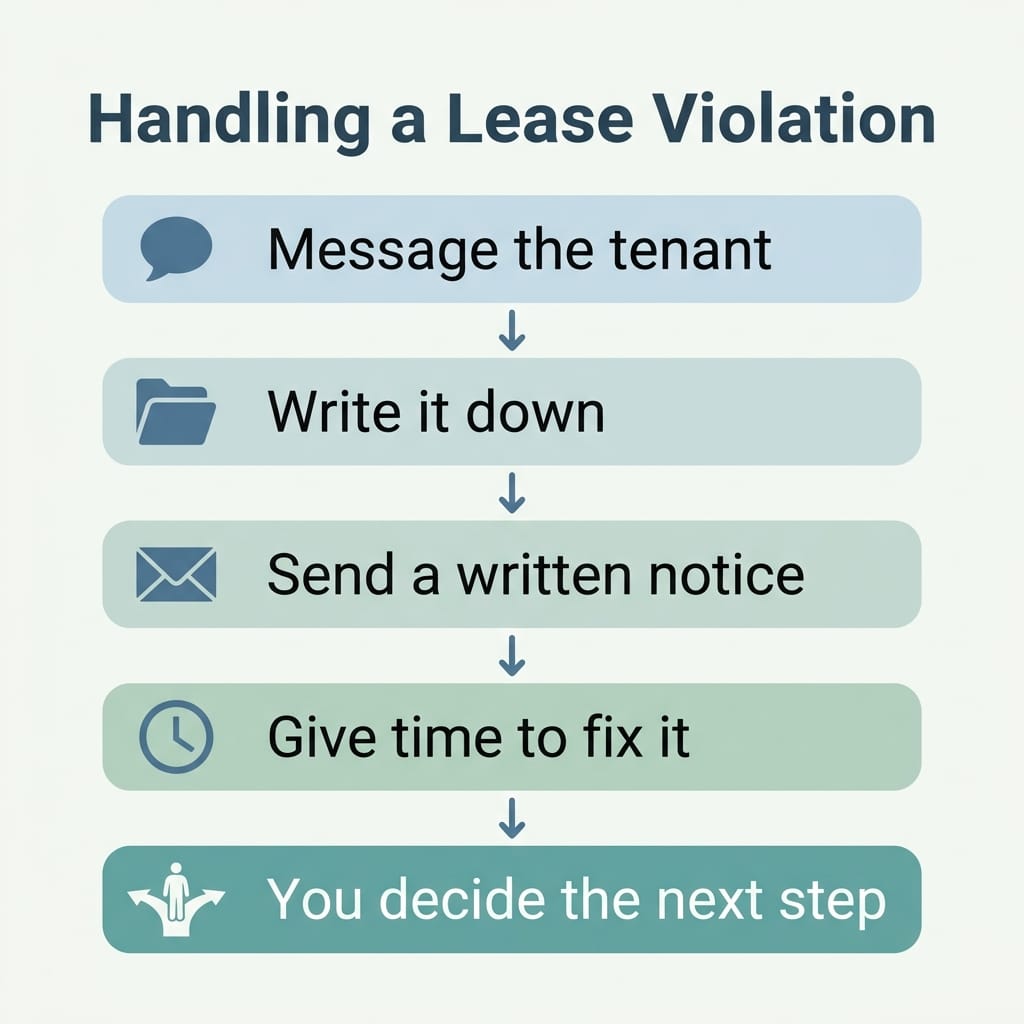
A good service handles a violation the same way every time: early, in writing, and by your state's rules. It sends the first message, keeps the record and tracks the deadline. You decide each step up the ladder. If it ever reaches court, that's your call too, made with local legal help.
The fear is a long, costly eviction. That fear is fair. Eviction is never quick, and it's never certain. That's why the real work happens early.
Most violations are ordinary. Late rent. A pet under a no-pet policy. Too much noise. Damage to the unit. Each one climbs the same ladder.
- Message the tenant. Who acts: the platform sends the reminder, or our team handles the conversation. You decide: how firm to be, and whether a short delay is fine.
- Write it down. Who acts: the platform. Messages, payments and documents sit in one record on Basic. You decide: what to add, like photos or neighbor complaints. The written record is what holds up later.
- Send a written notice. Who acts: you approve it. It names the problem and what fixes it. Your state sets the form, the delivery method and the timing. Clear lease terms help here, which is why Essential includes state-specific lease documents.
- Give the cure period. Who acts: the tenant. State law or your lease sets how long they have. If they fix it, it ends here. This is where you want it to end.
- Decide the next step. Who acts: you. If the tenant doesn't fix it in time, your state may let you move toward eviction. You can also work out a plan. Talk to a local attorney before a formal notice to end the tenancy.
- Go to court, only if you choose to. Who acts: you and your attorney. Eviction assistance is available as an add-on. In California, the California Attorney General states the only lawful way to evict is to file a case in court. In Arkansas, an owner must go through the legal process and get a writ of possession from a court before the sheriff can remove a tenant. Rules differ in every state.


Never change the locks, shut off utilities or remove belongings to force someone out. Go through the process.
Our Rental Assistant handles tenant conversations about noise complaints, HOA violations, lease questions and rent issues. Our team does the talking. You keep the decisions. This guide is general information, not legal advice.
Is it worth paying a service to handle tenant communication?
Pay for the part that costs you sleep. Simple messaging you can run yourself with good tools. The after-hours repair call is different. That's where a repair coordinator with 24/7 emergency support earns its fee. A full hand-off of tenant conversations suits owners who live far away or are stretched thin.
Repairs are the heavy part. In the same 2023 Zillow survey, 92% of owners put repairs or maintenance in their top three most demanding jobs. And 40% ranked it first. More than a third, 36%, wished they had known that managing a rental, including talking with tenants, would take more time than expected.
Slow repairs aren't just a hassle. They carry risk. Where an owner fails to keep a unit livable, tenants may withhold rent, push for repairs or go to court. The rules depend on your state. In California, for example, the owner isn't responsible under that duty for damage caused by the tenant, their family, guests or pets. Don't assume the same rule applies elsewhere.
Tenants don't text during business hours. The question is who picks up when they do.
Option | Monthly cost | Your time | After-hours coverage | Who it suits |
|---|---|---|---|---|
Do it yourself | No fees | Every message and every call | You | One nearby door and a flexible schedule |
Basic: software messaging | $30/mo, including a $28 platform fee | Less: messages, rent and documents in one place | You | Owners who want order, not a hand-off |
Essential: repair coordinator | $48/mo, including a $28 platform fee | Repair calls come off your plate | 24/7 emergency support | Owners tired of the 2 AM call |
Complete: management assistant | $86/mo, including a $28 platform fee | Routine work handled for you | 24/7 emergency support plus VIP support | Owners far away or with many doors |
Want the conversations handled end to end? Our Rental Assistant team replies within 3 hours during business hours. You keep decision-making control.
Be honest about the trade-off. Outside help costs money. It can also cost you direct control if the provider starts making calls for you. That's the line we hold. We take the work. You make the decisions.
The proof is in the volume. We've completed 61,218 service requests, and users rate us 5 stars. Owners on Hemlane see 70% time savings.
Manage your rentals on Hemlane
What should a landlord ask before hiring a tenant management service?
Ask about five things: cost, control, support, compliance and money flow. A good provider answers in plain numbers and written policies. A worrying one says "it depends" and won't put it in the contract. Take this list into every sales call, including ours.
The real cost of outside help is control. So test that first, and test it hard. Check public reviews and any complaints or legal issues filed against a provider before you sign.
Group | Ask this | Why it matters | A good answer | A worrying answer |
|---|---|---|---|---|
Cost | What is the full monthly price per unit? What costs extra? | Fees hide in add-ons | Exact plan prices, add-ons named | A quote only after you sign |
Cost | What happens when the trial ends? | You need to know the real bill | A clear per-unit price and billing terms | Vague or changing terms |
Control | Who approves applicants and sets the rent? | You're responsible for those calls | You do. They give you the reports | "We'll take care of it" |
Control | What reports do I get, and is that in the contract? | If it isn't written, it isn't promised | Named reports, written into the agreement | "You'll hear from us if something's wrong" |
Support | Who answers a tenant emergency at 2 AM? | Slow repairs carry legal risk | A named team, 24/7, with a dispatch process | Voicemail until morning |
Support | How fast do you reply to tenant messages? | Silence turns small issues into big ones | A stated response time | No number at all |
Compliance | Walk me through your screening process. | A good provider can explain its background and credit checks | Clear steps, same criteria for everyone | "It's automatic" |
Compliance | How do you keep screening fair-housing compliant? | You can be liable for a screening company's mistakes | Written criteria; you make the final call | "Don't worry about it" |
Compliance | Have complaints or legal issues been filed against you? | Your name is on the lease, not theirs | A straight answer you can verify | A dodge |
Money flow | Does rent go straight to my account? | Your money should stay yours | 100% of rent paid to you | Pooled accounts, unclear timing |
Money flow | Do you mark up repair invoices or keep any fees? | Markups quietly cut your income | Every fee named up front | "It's standard" |
Here's how we answer our own list.
- Cost. Starter is free. Basic is $30/mo, Essential $48/mo and Complete $86/mo, each paid plan including a $28 platform fee. Paid plans are priced per unit monthly after a 14-day trial, with discounts for annual billing. Add-ons cover tenant placement, inspections and eviction assistance.
- Control. We are not a property management firm. We make no decisions for you.
- Support. Essential adds a dedicated repair coordinator and 24/7 emergency support. Complete adds a vetted repair network and VIP support.
- Compliance. Essential includes state-specific lease documents. You stay responsible for following your state's laws.
- Money flow. We pay 100% of rent directly to you.
- Reviews. We hold 4.8-star user reviews on Capterra, GetApp and Software Advice.
Want to know who's behind the platform? Read about our founders, our scale and what customers say.
Frequently Asked Questions
Can a tenant management service collect rent on a landlord's behalf?
Yes. On our Basic plan, $30/mo including a $28 platform fee, tenants pay online and we pay 100% of rent directly to you. Your books stay current with bank sync, a cash flow report and an income statement.
ACH payments in general can clear within hours on the same business day, or be scheduled one or two business days out. Deposits are a separate matter, and each state sets its own rules. In Massachusetts, for example, the Commonwealth of Massachusetts says the owner must hold a security deposit in a separate, interest-bearing account at a Massachusetts bank. Check your own state's rules.
Do tenant management services work for landlords with just one rental?
Yes. Small owners are the norm, not the exception. A 2021 HUD and Census Bureau survey found nearly 46% of the 49.5 million U.S. rental units sit in properties of one to four units. Individual investors own 70% of those small properties.
Start free on Starter with screening, accounting and listings. Basic, at $30/mo including a $28 platform fee, adds rent collection and tenant messaging. Essential, at $48/mo, adds 24/7 emergency support. You get local support while you watch your rental from anywhere.
What is tenant management in real estate?
Tenant management is the part of running a rental that deals with the tenant. It covers the relationship between the owner, who leases the unit, and the tenant, who rents it. That means screening, leases, rent, messages, repairs and lease enforcement. It sits inside property management, which is the wider job of running a property for its owner.
Hemlane is a technology company that helps you manage long-term rentals. We're not a property management firm. We give you the tools and the people. You make the calls.
You keep every decision. We take the messages, the reminders and the late-night repair calls.
Get started with Hemlane
Hemlane, Inc. is a technology company that helps you manage your long-term rental properties. Communications between you and Hemlane are protected by our Privacy Policy. Hemlane also provides access to independent licensed professionals and self-help services at your specific direction. We are not a property management firm. We cannot make any decisions on behalf of any property owners. Any content found in the Hemlane Academy is not a substitute for advice and ideas from a qualified legal source or expert. You are responsible for performing additional research to confirm you are complying with all laws applicable to your rental situation.
Sources


- Consumer Financial Protection Bureau — Review your rental background check | Consumer Financial Protection Bureau · retrieved November 3, 2026
- Federal Trade Commission — Using Consumer Reports: What Landlords Need to Know | Federal Trade Commission · retrieved October 26, 2026
- U.S. Department of Housing and Urban Development — Housing Discrimination Under the Fair Housing Act | HUD.gov / U.S. Department of Housing and Urban Development (HUD) · retrieved November 3, 2026
- California Attorney General (State of California Department of Justice) — Attorney General Bonta Issues Legal Guidance for Law Enforcement Responding to Unlawful Lockouts and Self-Help Evictions | State of California - Department of Justice - Office of the Attorney General · retrieved November 3, 2026
- Commonwealth of Massachusetts — Security deposits and last month's rent | Mass.gov · retrieved November 3, 2026
- Cornell Law School Legal Information Institute — cure or quit | Wex | US Law | LII / Legal Information Institute · retrieved November 3, 2026
- Legal Aid of Arkansas — Lock Outs and Self-Help Evictions - Landlord/Tenant - Arkansas Law Help at Legal Aid of Arkansas · retrieved November 3, 2026
- Zillow Group — Landlords sound off: Maintaining properties and screening renters are the biggest hassles of property management - May 1, 2023 · retrieved November 3, 2026
- Cornell Law School Legal Information Institute — implied warranty of habitability | Wex | US Law | LII / Legal Information Institute · retrieved November 3, 2026
- California Department of Real Estate — Publications and Reports · retrieved November 3, 2026
- JPMorgan Chase — What Does a Property Manager Do? | Chase · retrieved November 3, 2026
- National Multifamily Housing Council — NMHC | NMHC Pulse Survey: Analyzing the Operational Impact of Rental Application Fraud and Bad Debt · retrieved November 3, 2026
- Consumer Financial Protection Bureau — CFPB Reports Highlight Problems with Tenant Background Checks | Consumer Financial Protection Bureau · retrieved November 3, 2026
- Virginia REALTORS® — HUD Fair Housing Guidance on Screening Tenants - Virginia REALTORS® · retrieved November 3, 2026
- LeadingAge — HUD Withdraws Wide-Ranging Fair Housing Policies · retrieved November 3, 2026
- Money — How to Hire Property Managers | Money · retrieved November 3, 2026
- Nacha — The ABCs of ACH | Nacha · retrieved November 3, 2026
- U.S. Department of Housing and Urban Development — HUD Archives: HUD and Census Bureau Release Findings of 2021 Rental Housing Finance Survey · retrieved October 26, 2026
- Cornell Law School Legal Information Institute — landlord and tenant | Wex | US Law | LII / Legal Information Institute · retrieved November 3, 2026
Get the Latest in Real Estate & Property Management!
I consent to receiving news, emails, and related marketing communications. I have read and agree with the privacy policy.


