
Property Management Software: 2026 Owner's Guide to Costs

Editorial Staff
Content published by Hemlane is created and reviewed by members of our editorial team, including experienced technical writers and real estate professionals.
Five tools. Five logins. Five places where a rent payment goes missing. Most owners shopping for software are tired of the patchwork. They are also wary of fees they can't see yet, and of the repair call that comes at 2 AM.
This guide is not a vendor roundup. It walks a rental from listing to renewal. It shows what software does, what still needs a person, what it costs and how it moves your income. You decide what fits.
What does property management software do for owners and property managers?
Property management software runs the paperwork side of a rental. It lists the unit, screens applicants, signs the lease, collects rent, logs repairs and keeps the books. It does not show the unit. It does not inspect it. It does not answer the 2 AM leak call. A person still does that, so the best setup pairs both.
Who uses it? Mostly owners. In 2021 survey data from the U.S. Department of Housing and Urban Development, only about 22 percent of 1 to 4 unit rentals were managed professionally. For buildings with 150 or more units, it was 84 percent. The same data found individual investors owned 70 percent of small rentals, about 15.9 million properties. For most small rentals, the person at the keyboard is the owner.
Here is the rental lifecycle, split into what software handles and what still needs a human.
Stage | What software does | What still needs a person |
|---|---|---|
List | Writes the listing, posts it to rental sites, gathers leads | Photos, showings, key handoffs |
Screen | Takes applications, runs credit, criminal, eviction and income reports | You make the call and send any required notices |
Lease | Builds the lease, collects e-signatures, tracks dates, stores documents | Move-in inspection, keys |
Collect | Takes rent online, sends reminders, tracks late fees, syncs the bank, runs reports | A real conversation with a tenant who falls behind, mediation, local court coordination |
Maintain | Logs requests, messages tenants, routes jobs to vendors | Someone to pick up at 2 AM, troubleshoot and dispatch, plus inspections |
Renew or turn over | Flags lease ends, relists the unit | Move-out inspection, turn work, new showings |
Our free Starter plan covers the front of that table. You get tenant screening with national credit, criminal, eviction and income reports. You get full rental accounting with bank sync, a cash flow report and an income statement. Your listing goes to Apartments.com, Zillow and 7 more top sites.
Each tier adds more. Basic adds lease tracking, document storage, rent collection and tenant messaging. Essential adds a dedicated repair coordinator, 24/7 emergency support and state-specific lease documents. Complete adds a property management assistant, access to a vetted repair network and VIP support. The full feature list is on our platform overview.
The right column is where software stops. Licensed local agents handle what software can't: showings, inspections, key handoffs and local-court coordination. We pair those agents with one platform, available across all 50 states. You get local help and watch it all from anywhere. See how local agents and 24/7 coordination work.
We support over 20,000 rental properties in 4,418 cities. Users rate us 4.8 stars on Capterra, GetApp and Software Advice. We've completed 61,218 service requests.
One thing never changes. Hemlane is a technology company, not a property management firm. You make every decision. We take the admin.
Owner or manager? A self-managing owner wants fewer hours, fewer fees and more of the rent kept. A property manager serves many owners. They need clear reports for each client, clean records across many accounts and a vendor network that makes them look good. Same stages. Different scorecard.
How can property management software improve a rental portfolio's net operating income?
Net operating income, or NOI, is what your rentals bring in minus what it costs to run them. Software can lift it by cutting empty weeks, catching late rent early, keeping repair bills honest and slowing turnover. It cannot fix rent set too high or a roof that's been put off. It speeds up a sound operation.
The formula is plain. Take rent plus any other income from the property. Subtract the direct costs of running it. What's left is NOI.
A subscription earns nothing by itself. Shorter vacancies and on-time rent do. So look at each lever.
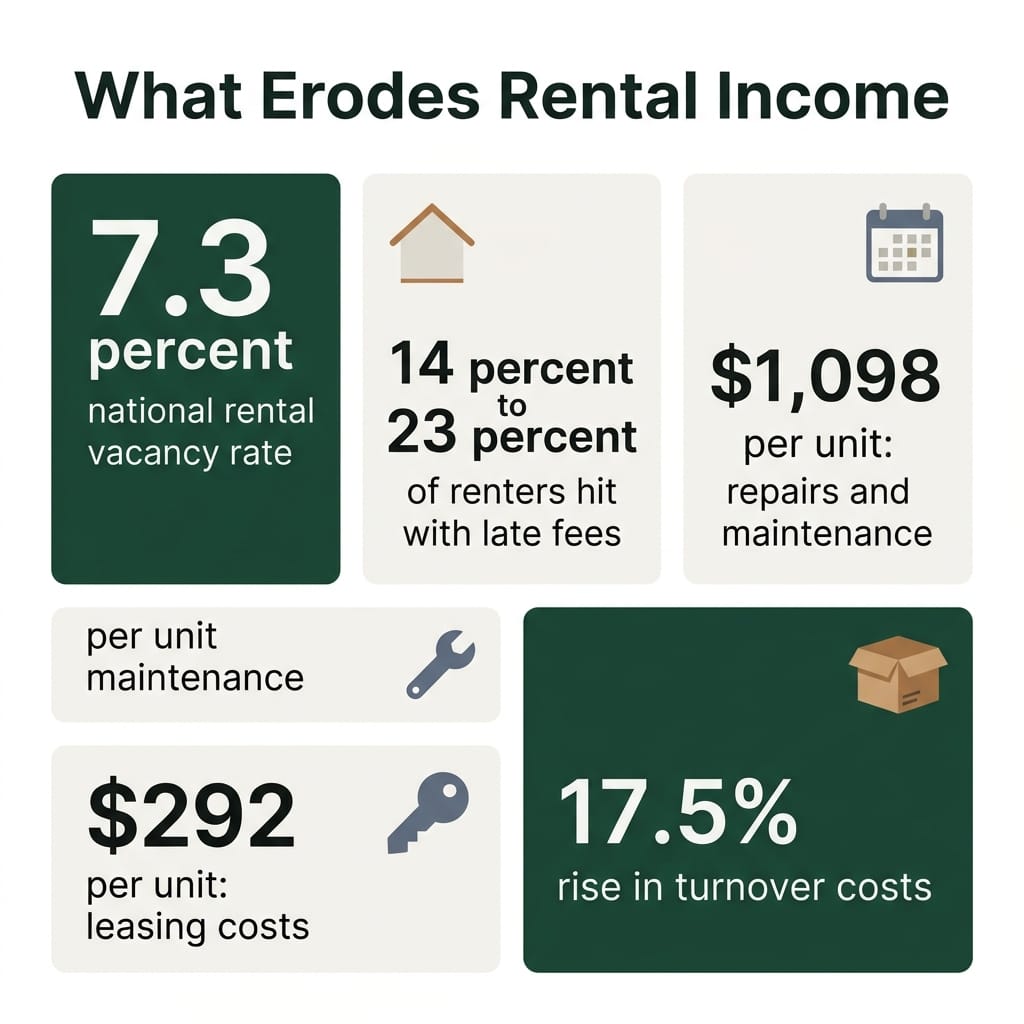
Vacancy. Rental vacancy nationally ran 7.3 percent in the second quarter of 2026, according to the U.S. Census Bureau. Every empty week is rent you never get back.
Late rent. Late fees are the most common sign of trouble. The Consumer Financial Protection Bureau found late fees reported for 14 to 23 percent of active renters. It also found about half of renters hit with a late fee go back to paying on time. Fast, steady follow-up matters.
Repairs and turnover. Data from the National Apartment Association put repairs and maintenance at $1,098 per unit in 2024, up 3.7%. Leasing costs rose to $292 per unit, pushed up by a 17.5% jump in turnover costs. Those are apartment-community figures, not single-family data. Your numbers will differ. The pressure points are the same.
Lever | The problem | What moves it | How to measure it |
|---|---|---|---|
Vacancy | Empty weeks earn nothing | Wide listing reach, fast screening, showings 7 days a week | Days on market per turnover |
Collections and late fees | Late rent stalls cash flow | Online rent, auto reminders, late fees paid to you, early mediation | Share of rent paid on time each month |
Repair cost | Markups and after-hours scrambles | A repair coordinator, invoices with no markups | Repair spend per unit per year |
Turnover | Each move-out costs turn work and leasing | Fast repairs, renewal reminders | Renewal rate, cost per turnover |
Owner hours | Your time is a cost too | One login, 24/7 coordination | Hours a month spent on the rentals |
Here is how we work those levers.
Our leasing services cut days on market by 26% and run showings 7 days a week. If vacancy is your biggest leak, see our tenant placement and leasing services.
On collections, we charge $0 ACH fees. 100% of rent goes to you. 100% of late fees go to you too.
When rent stops, our eviction services page reports most cases resolved through mediation and 95% avoiding court. No outcome is certain. A case that does reach court takes real time and money. Read how our mediation-first eviction support works.
Repairs are invoiced and paid with no markups. And our property management page puts owners' time saved at 70%.
An illustrative check. Take the apartment benchmark of $21,017 in total annual income per unit. Spread it across the weeks of the year, and every empty week costs a real slice of it. Our Essential plan is $48 a month on our current 2026 pricing, including a $28 platform fee. Set a full year of that plan against two weeks of benchmark income. It includes the repair coordinator and 24/7 emergency support. Avoid two empty weeks and the plan has paid for itself for the year. Swap in your own rent to run it for your unit.
How much does property management software cost?
Prices run from free to a few hundred dollars a month. Free tools cover listings and screening. Small-owner plans run about $25 a month, or a few hundred dollars a year. Software built for management companies starts near $62 a month and climbs to about $400. Paying more should buy service, not just more buttons.
Model | Published price basis | What it includes |
|---|---|---|
Free plans (our Starter) | $0 | Screening, rental accounting, listings to major sites |
Free-to-paid small-owner tool | Paid tier runs $149 to $349 a year, by portfolio size (per the tool's help center) | Software. You handle the in-person work |
Flat-rate small-owner plan | $25 a month for up to 10 properties. Higher tiers start at $50 a month and grow with units (per the tool's pricing page) | Software. You handle the in-person work |
Software built for management companies | Entry tier from $62 a month, mid tier from $192, top tier from $400 (per the vendor's pricing page) | Software for firms running many owners' accounts |
Hemlane Basic | $30 a month, incl. $28 platform fee | Lease tracking, document storage, rent collection, tenant messaging |
Hemlane Essential | $48 a month, incl. $28 platform fee | Adds a dedicated repair coordinator, 24/7 emergency support, state-specific lease documents |
Hemlane Complete | $86 a month, incl. $28 platform fee | Adds a property management assistant, vetted repair network access, VIP support |
Partner agent full service | $60 a month for the first rental, $30 for each additional, billed annually | Full service from a licensed local agent on Hemlane. Offered by some partners, not in every area |


Our paid plans are priced per unit, monthly, after a 14-day trial. Annual billing discounts are available. For a multi-door portfolio, compare our plans and add-ons line by line to see what applies to your door count.
The step that matters is the one that adds people. Essential is our first tier with a dedicated repair coordinator and 24/7 emergency support. That's the line between software that logs the 2 AM leak and a team that picks it up.
Manage your rentals on Hemlane
What hidden costs come with property management software?
The sticker price is rarely the whole bill. Per-payment fees, card fees, screening charges, setup fees and paid support tiers can all show up after you sign. So can the cost of work the software leaves undone, like after-hours repairs. Ask about every line below before you commit, and find out who pays it.
A per-payment fee looks tiny. One management-company vendor's pricing page lists $2.35 per incoming electronic payment. On one door, that's $28.20 a year ($2.35 × 12). Now count your doors.
Cost line | Who usually pays | Ask this |
|---|---|---|
Subscription base | Owner | Is there a platform fee on top of the per-unit price? |
Per-unit charge | Owner | What does each added door cost? |
Per-payment (ACH or EFT) | Owner or tenant | Is there a fee per rent payment? How many are free? One vendor charges $2.35 each. A flat-rate tool charges $0.50 per payment after one free per property each month |
Card payments | Owner or tenant, by setup | What's the percentage? One vendor lists 2.99% per transaction |
Screening | Owner or applicant | Who pays, and does the price change by plan? One vendor lists $17 owner-paid or $35 applicant-paid. On another tool's paid tier, applicants pay $45 instead of $55 |
E-signature | Owner | Included, or charged per document? |
Setup | Owner | Any one-time charges? One vendor lists $99 per business bank account set up |
Support tier | Owner | Is phone or priority help extra? |
Payout timing | Owner | How many days from tenant payment to my bank? |
After-hours coverage | Owner | Who answers a 2 AM emergency, and what does it cost? |
Lease documents | Owner | Are leases state-specific? Are they included? |
Exit | Owner | Can I export my data? Is there a term commitment or a cancellation fee? |
Fees passed to tenants are drawing attention too. The FTC said on March 13 it was seeking public comment on a possible rule. It would stop owners and managers from advertising rents without all mandatory charges, or adding fees without disclosure. If a platform charges your tenants, know exactly what and why.
Here's ours, in plain view.
- Platform fee: $28, included in each paid plan price.
- ACH fees: $0.
- Late fees: 100% go to you.
- Repairs: invoiced and paid with no markups.
- Tenant Placement: a flat fee, plus $100 for a digital lockbox.
- Leasing Services: a flat fee, listed with our add-ons.
- Pre-eviction service: a one-time fee.
- Ongoing mediation: billed per unit per month.
Essential includes 24/7 emergency support and state-specific lease documents, so those are not extra lines. Every plan and add-on sits on our pricing page.
What are the biggest mistakes owners make when adopting property management software?
Most adoption mistakes come from the setup, not the owner. The wrong plan size. Messy records. Everything switched on at once. Screening trusted to cover the law. Any of these can turn a helpful tool into one more chore. Each has a simple fix. Here are nine, with what to do instead.
- Buying for the wrong portfolio size. Tools built for firms with many client accounts can be overkill for a few doors. Capped plans can pinch as you grow. Instead: price each plan against your door count today and where you plan to be.
- Paying for features you won't use. A top tier full of firm-level tools is money spent on buttons. Instead: start on the tier that matches your work. Move up when you need service, like repair coordination.
- Importing messy data. Old tenant and vendor records carry old errors into the new system. One large vendor's setup guide gives three tips. Clean up tenant and vendor accounts. Use one consistent set of categories for your books. Switch over at the start of a month or quarter. Instead: do the cleanup first. Pick a clean start date.
- Switching everything on at once. The same vendor's guidance warns that rolling out every change at once overwhelms people. Instead: phase it. Start with rent and accounting. Add maintenance and leasing next.
- Leaving tenants on paper payments. Half on checks and half online means two systems to reconcile. Instead: move every tenant to online rent on your cutover date.
- Treating built-in screening as legal cover. Screening tools pull reports. They don't take on your legal duties. The Federal Trade Commission says tenant background reports are consumer reports, and using them for decisions means following the Fair Credit Reporting Act. If a report plays any part in rejecting an applicant, raising rent or deposit, or requiring a co-signer, you must give notice in writing, electronically or orally. The FTC's Disposal Rule also requires anyone keeping these reports for business to dispose of the sensitive information properly. Instead: our screening covers national credit, criminal, eviction and income reports. The decision and the notices stay yours. This is not legal advice. Confirm your own compliance.
- Using generic lease documents. Lease rules differ by state and sometimes by city. Instead: start from state-specific documents (Essential includes them) and check them against your local rules.
- No after-hours plan. The software logs the ticket at 2 AM. Nobody picks up. Instead: line up coverage before move-in. Our Essential plan includes 24/7 emergency support and a dedicated repair coordinator.
- Stacking separate tools. A listing site, a screening service, a rent app, a spreadsheet and a group text. Instead: run it in one place. We put leasing, screening, listings, rent collection, maintenance coordination and eviction support in one account.
Before you set up, our rental resources hub has free documents, state law guides and a rental calculator.
Frequently Asked Questions
How long does it take to set up property management software?
It depends on how many doors and records you're moving. The only published go-live figure is for firms. A large vendor, citing a G2 report, says property management firms go live on its platform within 1.6 months. That's for firms moving many accounts, not for an owner with a few doors. Small-owner tools often sell self-serve setup. One flat-rate tool advertises no setup fees, no term commitments and no training costs. Our Starter plan is free, and paid plans begin after a 14-day trial, so you can test it on your own units first.
What are the largest property management software companies?
The biggest vendors mostly serve large enterprise operators. The largest says it serves over 24 million units worldwide. A publicly traded vendor reported 9.8 million units under management in a recent quarterly filing, up 8% from a year earlier. Another vendor's securities filing says it powers 2.5 million units, roughly 10% of the U.S. multifamily market, with its strength among the largest operators. A trade profile of another big private vendor says only that it supports millions of units. Several small-business brands are owned by these enterprise vendors. These counts are self-reported and measured differently, so they are not a strict ranking. A big vendor isn't automatically the right fit. We serve owners and managers from one unit to 250.
What software do property management companies use?
Large operators often run legacy enterprise systems built for thousands of units. Many operators still run on spreadsheets, email and paper checks. That's a starting point, not a failing. The trend is toward fewer tools: in one large vendor's 2026 survey, 45% of operators said they plan to consolidate their tech stacks. We put leasing, screening, listings, rent collection, maintenance coordination and eviction support in one account. That replaces five disconnected tools and five vendor relationships. We serve owners, property managers and real estate agents.
You call the shots, we handle the rest. The admin, the listings and the 2 AM repair calls included.
Get started with Hemlane
Hemlane, Inc. is a technology company that helps you manage your long-term rental properties. Communications between you and Hemlane are protected by our Privacy Policy. Hemlane also provides access to independent licensed professionals and self-help services at your specific direction. We are not a property management firm. We cannot make any decisions on behalf of any property owners. Any content found in the Hemlane Academy is not a substitute for advice and ideas from a qualified legal source or expert. You are responsible for performing additional research to confirm you are complying with all laws applicable to your rental situation.
Sources


- U.S. Department of Housing and Urban Development — HUD Archives: HUD and Census Bureau Release Findings of 2021 Rental Housing Finance Survey · retrieved October 26, 2026
- U.S. Census Bureau — Housing Vacancies and Homeownership - Press Release · retrieved October 26, 2026
- Consumer Financial Protection Bureau — Behind on Rent? Examining Rental Housing Delinquencies in New Payment Data | Consumer Financial Protection Bureau · retrieved October 26, 2026
- National Apartment Association — From Momentum to Management: Navigating Elevated Costs in a Constrained Operating Environment | National Apartment Association · retrieved October 26, 2026
- Federal Trade Commission — Using Consumer Reports: What Landlords Need to Know | Federal Trade Commission · retrieved October 26, 2026
- Wall Street Prep — Net Operating Income (NOI) | Formula + Calculator · retrieved October 26, 2026
- Rentec Direct — Rentec Direct Property Management Software Pricing | Rentec Direct · retrieved October 26, 2026
- Buildium — Pricing - Buildium · retrieved October 26, 2026
- RealPage — About Us | Property Management Software Leader | Realpage · retrieved October 26, 2026
- AppFolio — From Property Management to Performance Management: AppFolio Report Shows AI Leaders Pulling Ahead · retrieved October 26, 2026
- AppFolio — 7 Expert Tips to Prepare for a Property Management Software Transition · retrieved October 26, 2026
- Federal Trade Commission — Disposal of Consumer Report Information and Records | Federal Trade Commission · retrieved October 26, 2026
- Bisnow — New FTC Rulemaking Targets 'Junk Fees' In Tough Rental Market · retrieved October 26, 2026
- AppFolio — AppFolio Onboarding Best Practices for 2026 · retrieved October 26, 2026
- Entrata, Inc. (SEC Form S-1) · retrieved October 26, 2026
- AppFolio, Inc. (SEC Form 8-K exhibit) · retrieved October 26, 2026
- HousingWire — Yardi - HousingWire · retrieved October 26, 2026
- Entrata, Inc. (SEC Form S-1/A) · retrieved October 26, 2026
- TurboTenant — Is There a Cost to Sign Up for TurboTenant? | Welcome to Our Help Center! · retrieved October 26, 2026
Get the Latest in Real Estate & Property Management!
I consent to receiving news, emails, and related marketing communications. I have read and agree with the privacy policy.


