
Landlord Tenant Management Software: Mediation vs Eviction

Editorial Staff
Content published by Hemlane is created and reviewed by members of our editorial team, including experienced technical writers and real estate professionals.
Rent is late. Your bills aren't. You may already be picturing a courtroom, a lawyer and months with no income. That fear makes sense. So let's give it a real size. Then let's build a plan that starts with a conversation, not a lawsuit.
Most pages about landlord tenant management software list features. This one covers the hard month those features exist for. We support over 20,000 rental properties in 4,418 cities across the United States. Here's what we'd tell any owner in your seat.
How much does evicting a tenant cost a landlord?
An eviction costs far more than the court fee. Research from the Stanford Institute for Economic Policy Research found owners act as if an eviction costs two to three months' rent. The same research found owners usually wait to file until a tenant is two or three months behind. So the loss often starts before court does.
That's two losses stacked. First, the rent you never collected. Then the cost of the case itself.
Here's where the money goes. These costs vary a lot from state to state, and even city to city. Read this as a map of what you pay for, not a price list.
Cost | Where it comes from | What pushes it up or down | Type |
|---|---|---|---|
Court filing fee | Your local court | Each court sets its own. Some charge more when you ask for more money. | Court cost |
Lawyer fees | An eviction attorney, if you hire one | Whether the tenant fights the case. How complex your state's process is. | Court cost |
Rent lost before filing | The months you wait to act | How early you step in | Lost income |
Rent lost during the case | The months the case runs | Tenant answers, trials, appeals, court calendars | Lost income |
Damage to the unit | Repairs after the tenant leaves | The unit's condition at move-out | Turnover cost |
Empty months after | Time to find and screen a new tenant | How fast you list, show and approve | Turnover cost |
Time and hassle | You | Paperwork, court dates, missed work | Your time |
Here's one real filing fee. The Superior Court in Santa Barbara, California, has listed $240 when the amount demanded is $10,000 or less. The same court lists $435 when the demand is over $25,000. That's one court's listing. Your court sets its own fee, so check its current schedule before you plan around a number.
Notice what's biggest in that table. It isn't the fees. It's the months.
Now compare that with acting early. Programs that step in before anyone files can help owners avoid court fees. They can also help tenants avoid an eviction record. That's the path we built our eviction services around. Our pre-eviction service is a one-time fee. Our ongoing mediation service is billed monthly, per unit. Neither one guarantees a tenant pays or that a case stays out of court. Both give you a structured way to try first. Set that against two or three months' rent.
If the tenant does leave, the next cost is the empty unit. We list to Apartments.com, Zillow and 7 more top websites. We screen applicants with national credit, criminal, eviction and income reports. And licensed local agents handle the showings and the in-person work of tenant placement, so your weekends stay yours.
How long does an eviction take?
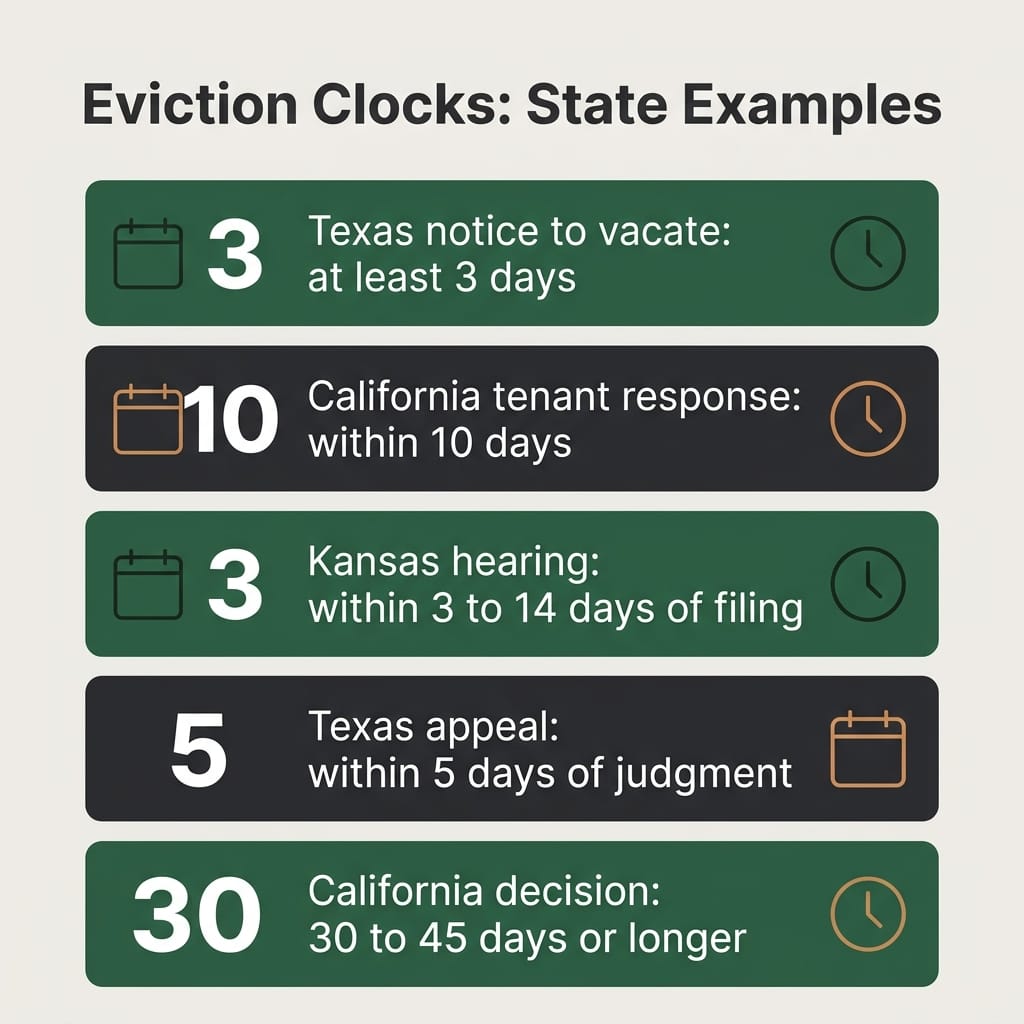
There's no single answer. Your state sets the clock, and the tenant's response can stretch it. In California, it can take 30 to 45 days or longer from the notice to a judge's decision. Appeals and the removal step can add more time after that. Here is how the stages run, using real state examples.
Stage | What happens | State example | What can slow it |
|---|---|---|---|
Notice | You give the notice your state requires | Texas: at least 3 days' notice to vacate, unless the lease says otherwise | A wrong notice or wrong delivery can mean starting over |
Filing | You file the case with the court | Texas: you can't file before the notice step | Missing or wrong paperwork |
Response | The tenant can answer the case | California: the tenant must file response papers within 10 days | The tenant files an answer |
Hearing or trial | A judge hears the case | Kansas: the hearing is set within 3 to 14 days of filing. California: if the tenant files an answer, there is a trial. | A contested case, a full court calendar |
Judgment | The judge decides | California: 30 to 45 days or longer from the notice | Delays at any stage before |
Appeal window | The losing side can appeal | Texas: an appeal must be filed within 5 days of the judgment | An appeal |
Writ and removal | A law officer carries out the court's order | Texas: a writ of possession is available 6 days after final judgment. The sheriff or constable must serve it within 5 days. The tenant gets a 24-hour notice to vacate. | The officer's schedule |
Look at the last row. Winning in court doesn't hand you the keys that day. Possession comes after judgment, through a law officer.
These are examples from Texas, California and Kansas. They are not national rules. Your state and city set your timeline.
Some of the delay is yours to prevent. These parts you control:
- Using the right notice for your state.
- Delivering it the way your state requires.
- Filing complete, correct paperwork.
- Keeping a clean record of rent, messages and notices.
These parts you don't control:
- Whether the tenant answers the case.
- Whether it goes to trial.
- Whether anyone appeals.
- The court's calendar and the officer's schedule.
Every restart costs you another month. Get the parts you control right the first time.
What should landlords do when a tenant stops paying rent?
Worried one wrong move will hurt your case? Slow down. Act early, write everything down, and try to work it out before you file. Some tenants do recover from a missed payment. And eviction can cost the same as several months of rent. So a short, structured effort first often makes sense. Here's the order we'd follow.
- Check the lease and the ledger. Confirm the due date, any grace period your lease sets, and the exact amount owed. Make sure the payment didn't just land late. Record to keep: your rent ledger.
- Contact the tenant, fast and calm. Ask what happened. Ask when they can pay. Keep it friendly and in writing where you can. Record to keep: your message log.
- Write everything down. Dates, amounts, promises, partial payments. If it isn't written, it's your word against theirs. Record to keep: notes in the tenant's file.
- Offer a way back. Propose a payment plan, or bring in mediation. Many courts run eviction diversion programs that connect owners and tenants with help outside a lawsuit. The National Center for State Courts explains how these programs work. Record to keep: the signed written plan.
- Decision point: is the deal holding? If payments come in on schedule, keep tracking them and let the plan work. If the tenant won't talk, or the plan breaks, move to the formal notice path.
- Send your state's proper notice. Use the form, length and delivery method your state requires. More on that below. Record to keep: a copy of the notice and the date and way you delivered it.
- Decide whether to file. This call is yours. Talk to an attorney about your state's process before you do. Record to keep: everything above, in one place, ready to hand over.
One line never moves. Removal goes through the court. In Washington, for example, owners must use a court eviction process and get an order signed by a judge. Changing the locks or shutting off the water feels like taking control. It isn't. It can sink your case.
This is where your tools matter. Five tools and five logins means five places where a payment or a message goes missing. Our Basic plan includes lease tracking, document storage, rent collection and tenant messaging. Full rental accounting covers bank sync, cash flow reports and income statements. Every tenant record sits in one place, and rent comes in with $0 ACH fees. When rent goes late, our eviction services add tenant mediation, legal notice support and attorney referrals. Owners rate us 4.8 stars on Capterra, GetApp and Software Advice.
You decide whether to file. We keep the payments, the messages and the notices together, so you're ready either way. Manage your rentals on Hemlane.
How does mediation help landlords avoid evicting a tenant?


Mediation puts you and your tenant together with a neutral person. The mediator listens to both sides and helps you find terms you can both accept. It can happen before or after a case is filed. No one is forced to agree. If talks fail, you can still go to court and let a judge or jury decide.
A judge can end a tenancy. A written deal can end the problem sooner.
The track record is strong. Most cases that go through an eviction diversion program end in a settlement or a voluntary dismissal. One Oregon county reports that four out of five of its mediated cases stop an eviction. That's one local program, not a national rate. In New Hampshire, the court recommends trying mediation before a case is filed. People who take part there give up no rights by doing so.
Here's how it runs from your side.
- Open the conversation. Tell the tenant you'd rather solve this than go to court. Say it in writing too.
- Bring in a neutral party. That can be a court program, a local program or a mediation service like ours. Ask your local court what it offers, before or after filing.
- Propose clear terms. How much is owed. How it gets paid back. By what dates. If staying won't work, a move-out date both sides accept.
- Put the agreement in writing. It should list the amount owed, each payment date, what happens if a payment is missed, any move-out date, and both signatures. In California, an agreement made in eviction mediation can say that if the tenant breaks it, the owner can get an eviction judgment without another trial. Ask the program or an attorney how that works where you rent.
- Watch the payments and know your fallback. Log every payment against the plan. If the deal breaks, you move to your state's notice path with a full record in hand.
Be honest about the limits. Mediation doesn't always work. It isn't the right tool where anyone's safety is at risk. And a private agreement doesn't carry court force by itself, unless it's made through the court or approved by one.
Our own record: on our eviction services, 90% of cases are resolved through mediation and 95% avoid court. Our mediation is a service you choose, not a court program. It sits right next to your rent ledger and message history, so every term and every payment is in one place.
What notices does a landlord have to send before filing an eviction?
Usually, a written notice that tells the tenant to pay or leave, sent before you file. Your state decides its name, its length, how it's delivered and what it can demand. A mistake can get the case thrown out and force a restart. This is general information, not legal advice. Here's how much two states differ.
Take this section slowly. It's where owners lose the most time to small errors.
In California, the California Courts Self-Help Guide describes the 3-day notice to pay rent or quit. In Texas, the Texas State Law Library describes the notice to vacate. Side by side:
Rule | California: 3-day notice to pay rent or quit | Texas: notice to vacate |
|---|---|---|
What it tells the tenant | Pay the rent or move out within 3 days | Move out |
Notice length | 3 days | At least 3 days, unless the lease says otherwise |
How days count | Saturdays, Sundays and court holidays don't count | Confirm with the state's guide or an attorney |
Delivery | Confirm the allowed methods with the state's guide | In writing, unless a written lease allows electronic delivery |
What it may demand | Rent only. Not late fees, utilities or damages. | Confirm with the state's guide or an attorney |
When filing can follow | Only after the notice period runs | Not before the notice step |
Two traps stand out. In California, counting weekends can make your notice too short. Adding late fees or utilities to a pay-or-quit notice is another common slip. In Texas, your lease can change the notice period and decide whether email counts. So read your lease first.
These are two states. They are not national rules. Your state, and sometimes your city, set your notice. Confirm both before you send anything.
This is where records protect you. Our lease management creates state-specific leases and keeps every tenant record in one place. Our Essential plan includes state-specific lease documents. When it comes to notices, our eviction services offer legal notice support and attorney referrals. That support helps you get organized. It doesn't guarantee a valid notice, and it doesn't replace an attorney. What it does give you is a dated record of what you sent and when.
Frequently Asked Questions
Can a landlord accept partial rent during an eviction?
It depends on your state, and the answer can change your case. In some states, taking part of the rent can cancel your right to end the tenancy unless you follow specific written steps. Ask before you cash anything. Two states show how different the rules can be.
In Arizona, an owner doesn't have to accept partial rent. If you do accept it, you keep the right to proceed only if the tenant agrees in writing, at the same time, to the terms of that partial payment. That written agreement must state the date the rest of the rent is due.
In Oregon, accepting partial rent generally waives your right to end the tenancy for nonpayment. There are exceptions. One is a written agreement, made after you give the nonpayment termination notice, that says accepting the payment is not a waiver.
A written agreement won't protect you in every state. Check your own state's rule. Whatever you decide, log every partial payment. Our rental accounting records each one, so you always know what's owed.
Can a landlord change the locks on a tenant who won't pay rent?
No. Changing the locks feels like taking control. It isn't. The lawful route is the court process. Only a court order, carried out by a law officer, can remove a tenant. Self-help moves like lockouts can turn a strong case into a costly one.
Minnesota is one clear example. LawHelpMN, a Minnesota legal aid source, says an owner can never force a tenant out without a writ and a law officer. It also says an owner can't change the locks, shut off utilities, move belongings outside, or remove or board up doors and windows to make a tenant leave.
Washington law, RCW 59.18.290, also bars owners from changing the locks or keeping a tenant out without a court order. Rules differ by state, but the safe path is the same: go through the court.
Can landlords refuse tenants with housing vouchers?
It depends on where your rental is. Under the federal Housing Choice Voucher program alone, taking part is voluntary. But some states and cities have their own rules about how renters pay. Those can change your answer, so check your state and local law before you decide.
Once you do take part, rules apply. For example, you can't charge a voucher family more for the same unit than a family renting a similar unit without a voucher.
Screen every applicant the same way. Our screening covers national credit, criminal, eviction and income reports, applied evenly to everyone who applies.
Late rent is a problem with a process. Price it honestly. Start with a conversation. Keep every record. Know your state's rules, and never take a shortcut around the court. You call the shots, we handle the rest. Get started with Hemlane.
Hemlane, Inc. is a technology company that helps you manage your long-term rental properties. Communications between you and Hemlane are protected by our Privacy Policy. Hemlane also provides access to independent licensed professionals and self-help services at your specific direction. We are not a property management firm. We cannot make any decisions on behalf of any property owners. Any content found in the Hemlane Academy is not a substitute for advice and ideas from a qualified legal source or expert. You are responsible for performing additional research to confirm you are complying with all laws applicable to your rental situation.
Sources


- Stanford Institute for Economic Policy Research (SIEPR) — Regulating evictions: The role of landlords | Stanford Institute for Economic Policy Research (SIEPR) · retrieved November 3, 2026
- National Center for State Courts — Getting started with eviction diversion | National Center for State Courts · retrieved November 3, 2026
- Judicial Branch of California (California Courts Self-Help Guide) — Types of eviction notices landlords | California Courts | Self Help Guide · retrieved November 3, 2026
- Texas State Law Library — The Eviction Process - Landlord/Tenant Law - Guides at Texas State Law Library · retrieved November 3, 2026
- LawHelpMN (Minnesota legal aid) — Lock-Outs and Shut-Offs to Evict Are Illegal | LawHelp Minnesota · retrieved November 3, 2026
- Judicial Branch of California (California Courts Self-Help Guide) — Mediation in eviction cases | California Courts | Self Help Guide · retrieved November 3, 2026
- National Center for State Courts — Reimagining housing court: a framework for eviction diversion | National Center for State Courts · retrieved November 3, 2026
- Clackamas County, Oregon — Housing Mediation | Clackamas County · retrieved November 3, 2026
- New Hampshire Judicial Branch — Landlord/Tenant - District Division | New Hampshire Judicial Branch · retrieved November 3, 2026
- Judicial Branch of California (California Courts Self-Help Guide) — The eviction process for tenants | California Courts | Self Help Guide · retrieved November 3, 2026
- Kansas Judicial Branch — Housing - Kansas Self-Help · retrieved November 3, 2026
- Urban Institute — The End of the National Eviction Moratorium Will Be Costly for Everyone | Urban Institute · retrieved November 3, 2026
- Superior Court of California, County of Santa Barbara — Evictions/Unlawful Detainers | Superior Court of California | County of Santa Barbara · retrieved November 3, 2026
- WashingtonLawHelp.org (Northwest Justice Project) — Illegal lock outs and utility shut offs | Washington Law Help · retrieved November 3, 2026
- Arizona State Legislature (A.R.S. 33-1371) — 33-1371 - Acceptance of partial payments; waiver of right to terminate; exception · retrieved November 3, 2026
- Oregon Revised Statutes (via Public.Law) — ORS 90.417 – Duty to pay rent; effect of acceptance of partial rent · retrieved November 3, 2026
- Durham Housing Authority — Frequently Asked Questions about HCVP - Durham Housing Authority · retrieved November 3, 2026
Get the Latest in Real Estate & Property Management!
I consent to receiving news, emails, and related marketing communications. I have read and agree with the privacy policy.


